Politics / News, Politics / News

6 Interesting Facts about the Iraq War

interesting iraq war factsInteresting Facts about the Iraq War

(for the average reader)

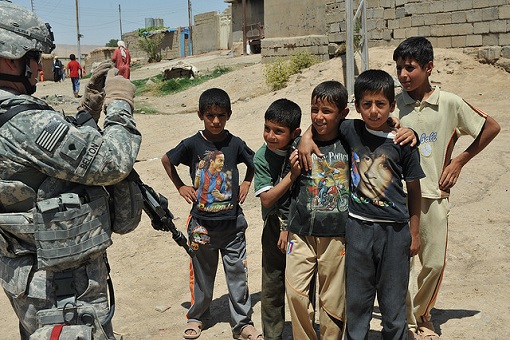
 While many people hear about the “War on Terror” as a catch phrase thrown around on propaganda filled, politically biased, lie-filled news stations most people couldn’t even point to the country in question. A lot of misinformation is thrown around in regards to the Iraq War either for sensationalistic purposes in an attempt to please corporate sponsors with better ratings or for politically motivated agendas. In reality a lot of people have no real idea why the war was fought, who against (IE: who’s doing the actual fighting), or in some cases where it all is even taking place. There is a lot of information about the Iraq War beyond what can be found in conventional sources.

Fact #1. Many of the “terrorists” are young, well-educated college students (and some aren’t even “terrorists,” they’re just paid thugs)

The general depiction of middle-eastern terrorists is of the equivalent to what we in the United States would consider a redneck. Generally older, “gibberish” speaking, bearded suicide bombers. While movies like Team America, True Lies, or Iron Man don’t help this stereotype in all actuality most of the extremists are attending, or were enrolled in prominent universities. They are between the ages of 20 – 27, male, and often know multiple languages including English in some cases. Much like the radicals seen during the 60’s in the United States or the Occupy Wall Street movement of 2011. Additionally, the motives of these Iraqi fighters are not “death to America” as often is depicted but more out of a religious extremism also seen with certain factions of Christians in the United States. What sets these individuals apart from some of the more radical elements in the United States is nothing more than semantics more often than not. Furthermore, in our briefings before going to Iraq, we were informed that a lot of the fighters in Iraq and Afghanistan were just paid thugs. The terrorists/insurgents would go out and find impoverished people, maybe just a young man trying to feed his family, and the terrorists would offer him money to maybe place a bomb on a street, or fire a few mortars on an American base, etc. Even suicide bombers are not always “fanatics.” There have been many reports of terrorist groups, various people, and even entire countries, offering money, as high as 25,000, for anyone who will wear a suicide vest (the money would go to their family of course). This many seem ridiculous that someone would do it for the money, but in war-torn countries where the life expectancy is already lowered, and fighting is an everyday occurrence, the thought of being able to provide for your family can be and overriding feeling (and I’m sure there’s still a little religious fanaticism involved, but there’s a good bet that a lot of these people wouldn’t have worn the vests without money going to their families).

Fact #2. Believe it or not: the wars in Afghanistan and Iraq are two different things

While these two wars often get lumped together they are two separate conflicts. The war in Afghanistan was a result of the hostile actions taken against the United States by a militant group believed to have originated and was currently in control of Afghanistan: Al-Qaida. On the other hand, the war in Iraq occurred as a result of, then believed, the countries possession of weapons of mass destruction IE: chemical, biological, nuclear based weapons. While over time these two conflicts have merged into a universal conflict they did not have a singular theme at the time of the United States involvement

Fact #3. Believe it or not: Iraq and Afghanistan are not geographically connected, or even that similar

Much like the specific conflicts and their origins, many people consider the countries as one place or even geographically connected. This is far from the truth. Iraq and Afghanistan are over 1000 miles apart, separated by Iran. Additionally the cultures of both countries are vastly different. Iraq’s economy is almost entirely based on the oil industry that is responsible for almost 90% of the world’s oil. Afghanistan, on the other hand, is agrarian at best with the majority of Afghan citizens living below the poverty line (and a lot of profits actually come form poppy fields–in fact to keep tribal leaders happy, some U.S. military units were actually tasked with protecting the poppy fields from the Taliban). Afghanistan is far more similar to rural places in Africa than it is to Iraq.

 Fact #4. The actual Iraq War lasted a little over a year

Despite popular belief, the most recent Iraq War ended in 2006 with the death of Saddam Hussein–with many prominent American’s even declaring it over at that time. After Saddam’s death a new government was put in place, however, there has been constant infighting between the two dominate Islamic religions, Sunni and Shiite, for control of the country. Combine this with various actions on the part of smaller, more extremist groups vying for control. As a result of this chaos, the United States along with many other countries and international organizations have had to moderate the violence within the country. The ongoing struggle is a direct result of the conclusion of the war.

Fact #5. The whole country isn’t constantly in a state of Chaos

A lot of the pictures and videos we see coming from Iraq are of various bombings and shootings, etc. However, outside the city of Baghdad and a few specific locations the majority of the country is relaxed and living life like any other day. Similar to what you would see in the United States after a major natural disaster. While citizens in places near the coast of Florida can be seen trying to pick up the pieces after a hurricane, residents in unaffected areas of Florida or even other states go about their lives like they would normally. Most Iraqis get up, go to work, and come home, repeat just like we do.

Fact #6. The prominent threat is homemade bombs

We see a lot of gun fighting and such on TV and in movies related to the Iraq war but the major problem isn’t from one on one combat but from Improvised Explosive Devices (IEDs). These can range from a plastic jug of gasoline with a fuse to cell phone detonated explosives. The issue with these compared to standard gun fights are that the extremists using them do not have to be present when they go off or even been within trigger range in some cases. Much like landmines during WWII, these are often set it and forget it type of weapons that can result in casualties and fatalities for both the intended target and any unintended personnel. Additionally, since they can be made out of anything, finding and defusing these devices is akin to finding a needle in a hay stack–a needle that will explode if you don’t find it.

Picture: Flickr/The U.S. Army
MFA Notes, Uncategorized

MFA Notes: The Subconscious Editor

the subconscious editor lesley university mfa low residencyQuick Notes: The Importance of the subconscious editor

Recently, I graduated from Lesley University with an MFA in creative writing, and I decided that I wanted to share what I learned in a series of blog posts.

I decided to share for two reasons:

1) My notes, although not too detailed, could possibly  help other writers.

2) Rewriting my notes forces me to re-read and re-think everything I learned, so it’s a win-win.

But before we dive in, please keep two things in mind:

1) These notes are neither complete nor perfect. The classes at Lesley were not typical lecture/note classes; the classes were filled with writing and thinking exercises and often this left no time for notes (in a good way). However, even with that, these sparse notes, I do believe, could still offer value.

2) I may, from time to time, include actual writing prompts from the classes, please bare with me, they’re first drafts and were done in the moment.

I hope you enjoy this series of notes and if you have any questions about the notes, Lesley University, or MFA’s, please feel free to contact me.

The Subconscious Editor

Your subconscious editor (who you are) writes, and the reader reads with their subconscious editor (who they are).

The voice from the subconscious editor: Go into your natural voice and use that.

How far back in time does one look at the soil from where a tree has grown?

If you write with your honest humanity, then people will read with their honest humanity.

All stories are local first, but are universal once it makes a connection.

The first “I” shouldn’t be you, it should be the “seeing eye.”

It’s not about you, it’s about the observations from your prism.

If you have writer’s block then you need to inspire your soul.

It’s the subconscious editor who writes. You need to live a writerly life and feed your subconscious editor.

Where does the subconscious editor come from? – It is the sum of who you are looking back at you.

What is the loam that made you who you are?

How do you view the world? And why?

What is your subconscious editor’s quest?

The subconscious editor makes the world is sees.

Click here to see more MFA Notes

Recommended book for this section: Drumblair, by Rachel Manley.

Picture: Flickr/Graham Holliday

Blogishness, Blogishness, ptsd

What is Kratom? And how can it help veterans with PTSD?

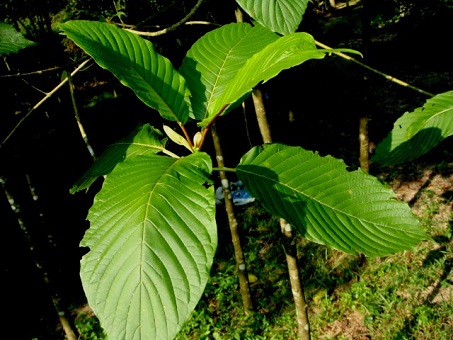
large leaf plant kratom ptsdPTSD and the herb Kratom

In this day and age of pharmaceutical giants peddling a new drug every week and then spending the next several decades in court over litigation related to the drug, it’s hard to trust some of these medications. However, with the growing boom of home remedies and homeopathy more and more people are turning to natural cures. While some of these remedies for pain and other issues are still illegal or require a very specific prescription, there are other options on the market to help relieve suffers. Kratom, for example, is one of these newer natural remedies.

 What is Kratom?

Kratom, is a leafy plant indigenous to parts of Southeast Asia. This plant is often used for pain relief and to reduce and assist with the withdrawal symptoms from opioids. Kratom works in a very similar fashion to morphine. While the plant is chewed recreationally it does not produce heavy psychoactive or other major side effects. Additionally Kratom use has been tied to an increase in overall mood. Typical users in Thailand have been said to start around 25 and continue through the rest of their lives.

Kratom side effects

While general use of Kratom doesn’t produce major side effects, chronic use has been known to lead to such things as:

  • constipation
  • darkening of the skin color of the face
  • loss of appetite
  • weight loss

Additionally the addictive properties are not fully known but reports of those who inject opioids becoming addicted to Kratom have been noted.

More studies required

Currently there is little to no studies related to Kratom as its use is only just now becoming more prevalent. To add insult to injury many countries have taken legal action in regards to Kratom despite no evidence for or against its use. It is believed that many of these countries are over-reacting due to archaic and draconian beliefs related to similar substances. There are even those that believe the regulation and overzealous reactions are tied to extensive funding from pharmaceutical entities in an attempt to continue to monopolize the health care industries. While some of these beliefs are unfounded the truth of the matter is currently Kratom, its effects and use are not fully understood by the scientific community

Kratom for PTSD

 Compared to most PTSD or other anti-anxiety drugs, Kratom shows considerable promise in the treatment and management of the condition. While, like many psychological conditions, it will not cure the user it does allow them to retain a normal life while getting treatment. Unlike typical pharmaceutical treatments that can have a range of devastating side effects from agitations, hallucinations, or even increase in suicidal thoughts, Kratom is by far a greater option. However, as mentioned further study is still required, Kratom currently tends to work far better and have lesser side effects compared to traditional treatments. Most users describe the feeling as being in the moment. The past and future become irrelevant as you only focus on the here and now. It allows you to let go of any past trauma or any future worries. You only think about what needs to be done to improve your current situation. For people with PTSD this can be like coming out of a fog on a dark, overcast day to a world full of sunlight and smiling faces.

Kratom + therapy

As mentioned Kratom does not cure psychological problems like PTSD however, it does allow its users to better work though their past traumas objectively. This allows them to better understand the core of the trauma as well as address any potential underlying issues without the inherent anxiety or fear that is often prevalent when addressing the trauma. Compared to pharmaceutical remedies that, as mentioned, can have severe side effects in addition only help to mitigate issues tied to the trauma not help deal with the drama; it’s no wonder that some people believe the pharmaceutical industry is behind the blacklisting of this herb.

Conclusion

PTSD is a complicated psychological ailment with ties to other related psychological issues such as, anxiety, depression, suicidal thoughts, etc. Dealing with one element of this all-consuming condition is akin to replacing the flat tires on a car with a busted engine. While pharmaceutical treatments do help mitigate some of the issues tied to PTSD they often only cover one maybe two per individual drug. In many cases people end up having to take 3 or more different drugs just to try and live some semblance of a normal life. Kratom, on the other hand deals with a lot of the issues tied to PTSD, while both causing minimal adverse effect as well as enhancing standard therapeutic treatment. Despite the misinformation campaigns and misguided anti-drug laws Kratom deserves a fair shot if for no other reason than to provide the peace of mind that all PTSD suffers long for and many cases outright deserve.

Picture: Flickr/Ahmad Fuad Morad

MFA Notes, Uncategorized

MFA Notes: Life as a Public Writer

life as a public writerQuick Notes: Lesley University MFA: Q & A: Life as a public writer

Recently, I graduated from Lesley University with an MFA in creative writing, and I decided that I wanted to share what I learned in a series of blog posts.

I decided to share for two reasons:

1) My notes, although not too detailed, could possibly  help other writers.

2) Rewriting my notes forces me to re-read and re-think everything I learned, so it’s a win-win.

But before we dive in, please keep two things in mind:

1) These notes are neither complete nor perfect. The classes at Lesley were not typical lecture/note classes; the classes were filled with writing and thinking exercises and often this left no time for notes (in a good way). However, even with that, these sparse notes, I do believe, could still offer value.

2) I may, from time to time, include actual writing prompts from the classes, please bare with me, they’re first drafts and were done in the moment.

I hope you enjoy this series of notes and if you have any questions about the notes, Lesley University, or MFA’s, please feel free to contact me.

Life as a Public Writer

Writer down your artistic statement: Who am I as a writer?

Just keep writing. If you don’t write for a while, don’t beat yourself up, forgive yourself and then keep writing. The only thing you control is the work.

[Separate the business-hat from the writer-hat.]

*Work shopping – Just because a piece can make it through a workshop without too much objection or abuse doesn’t mean it’s good. The good stuff should raise objections, it should offend and should invite abuse. (This doesn’t mean to write sloppy. But often it’s the “safe,” writing which is the least objectionable.*

Poetry is a performative act.

You’re constantly changing as a writer.

The readers and critics really only know an idea of me, not the real me.

Don’t let bad reviews get to you. Don’t take reviews personally-good or bad. Never give up!

Click here to see more MFA Notes

Recommended book for this section: Unless It Moves the Human Heart, by Roger Rosenblatt.

Picture: Flickr/Damian Gadal

Politics / News, Politics / News, ptsd, Self Improvement / Healthy Living, Uncategorized

Is PTSD Genetic? Can PTSD be passed onto my children?

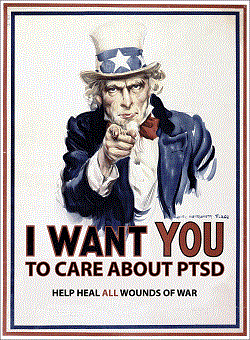
ptsd uncle sam recruitment poster ptsdIs PTSD Genetic?

Can PTSD be passed onto my children?

Post-Traumatic Stress Disorder (PTSD) is a psychiatric ailment that affects many people around the world. This stress disorder can affect anyone and it is typically caused by uncontrollable or unpredictable traumatic events. In most cases, PTSD symptoms appear after several days or hours of certain event. However, there are times that it takes up to few months or weeks for the symptoms to manifest themselves. Common PTSD’s causes may be because of sudden death of loved ones, assault, car or plane crashes, rape, war, natural disasters, kidnap, childhood neglect, physical abuse and other traumatic events.

“Avoiding being reminded of the event, including becoming detached from friends and becoming emotionally withdrawn, is another sign of PTSD.”

But can we tell just by taking a simple blood test if we are predisposed genetically to PTSD? This question has been the biggest issue internationally. International researchers have found a genetic marker that is linked to PSTD in the blood samples of the conflict zone based Marines. This team of researchers is studying to figure out who is more resilient to PTSD, and who is more at risk for PTSD.

Women are more likely to develop this stress disorder than men. Signs tend to cluster into three main areas. One is when a person relives the event through vivid images and nightmares together with an extreme reaction like heart palpitations, uncontrollable shaking and chills. Avoiding being reminded of the event, including becoming detached from friends and becoming emotionally withdrawn, is another sign of PTSD. The last main signs of this disorder are when a person is hyper aroused, irritable, startled easily, and/or has difficulty concentrating and trouble sleeping.

The idea that your genes play a role in whether you develop this stress disorder has been a famous focus of frequent research. Scientists have actually discovered, in mice, the genes that regulate fear. The lack of a brain chemical that is regulating the fear (which is called peptide that releases gastrin), led to fear response that is greater among rodents. In another study, mice that do not have a protein that is necessary to form the so called “fear memories”, have less tendency of freezing up and willing to explore unfamiliar spaces (think of the cartoon Tom and Jerry, and how Jerry (the mouse) wasn’t afraid of Tom the cat. This could have, realistically, been because Jerry lacked a certain protein in his brain that would’ve told him to be afraid of Tom). This is important to note because many people believe that PTSD is an unnatural response, but PTSD can often be a natural response to a somewhat unnatural situation. The brain is almost wired to respond in such a way.

“It’s been said that a single person with PTSD infects/affects/effects up to seven individuals with symptoms.”

There are also studies on twins which show that heredity is accounting for about 30 percent of the differences responding to trauma. Identical twins are much more likely to develop this stress disorder than the fraternal twins. Another research has looked into the role of inherited mental disorders, brain differences or tendencies of addiction.

An unusual research avenue is the contribution of our immune systems to the development of the symptoms of PTSD or if it has also a big role in this development. Prior studies showed that people who have been diagnosed with PTSD as compared to individuals without PTSD suggest that their differences in their genes in relation to inflammation, plays a role.

Therefore, there is a tendency that PTSD can be acquired genetically, however, there is no positive result as researchers are still going on progress of having some clues as to what may predict resilience and risk.

One thing to keep in mind about PTSD, is that even though it may or may not be genetic, a father or mother can still pass on PTSD to their children, and loved ones, through proximity. It’s been said that a single person with PTSD infects/affects/effects up to seven individuals with symptoms. Think of it as the flu. A father gets sick with the flu: he’s lethargic, has a fever, diarrhea, and he’s nauseous. Several days pass and the father’s son gets sick. The son has all the same symptoms as his father, he’s lethargic, nauseous, has diarrhea, etc. Then, the next thing you know, the sister gets sick, the mother, and the whole house is laid up in bed. Now, take that same scenario and imagine a man with PTSD. He’s irritable, short-tempered, has trouble sleeping, is anxious, and is emotionally withdrawn. How long do you think it’ll be before his short-temper and irritability is passed along to his wife and children?

In a sense, it’s the old nature vs nurture debate. Are we predisposed to PTSD or brought up into it?

Picture: Flickr/Ilona Meagher

Best Of, Blogishness, Blogishness, Book Notes, MFA Notes

Annotative Essay on the book: ‘Netherland,’ by Joseph O’Neill

Why We Read

netherland joseph o'neill annotative essay

An Annotative Essay on: Netherland, by Joseph O’Neill

            Different books are read for different reasons. Textbooks are read so that we can be informed in what matters most to us: math, biology, philosophy, etc. Suspense and thriller books so that we can be entertained by what interests us: vampires, the mafia, war, etc. Romance novels so that we can be enthralled in what eludes us: love, passion, desire, etc. And the classics so that we can be left pondering why certain things matter, interest, and elude us.

“Yet something eluded the book itself which kept it from entering such a category.”

What about a book, though, which fits into none of the previously outlined categories? Or what about a book that fits into all of them? Or half of them? This is where Netherland lays. Although I thoroughly enjoyed the book by Joseph O’Neill, when trying to classify it I ran into trouble. Well written and a page-turner, though not as entertaining as a Dean Koontz or Stephen King novel, nor as thought provoking as a classic like Catcher in the Rye; where then, does that leave a book, and all others like Netherland? It is classics which contain ‘All of the above.’ Netherland, I believe, had the makings of a classic. It had suspense, mystery, it informed me in subtle ways about life and philosophy, it enthralled me, though briefly, in passion and desire and things which elude the typical life. All things which make a classic. Yet something eluded the book itself which kept it from entering such a category. Thus, I believe Netherland joins the throws of bastard children. It fits nowhere. And this is where it gave the most instruction.

Even though I believe Netherland to be a good, though, unremarkable book, there was a lot to be learned. Both from the parts I enjoyed and disliked. The first issue, and eventual learning, I dislodged from Netherland was the art or dis-art of description. There were many descriptions which made me stop and appreciate the care and revisions in which the author must have gone through to create such a finely tuned well-crafted sentence; while simultaneously, there were several descriptions that I simply skipped over because they were simply, or un-simply, too much.

“As I repeatedly went forth with him and began to understand the ignorance and contradictions and language difficulties with which he contended, and the doubtful sources of his information and the seemingly bottomless history and darkness out of which the dishes of New York emerge, the deeper grew my suspicion that his work finally consisted of minting or perpetuating and in any event circulating misconceptions about his subject and in this way adding to the endless perplexity of the world.”

The above is merely an example of an eighty word sentence that the author used to get across a simple idea. It is one of many such examples. My issue with such writing is that if there’s a forty-five word sentence about how angry a person is, but by word eight I realize that the author is simply describing a basic state of anger; I say to myself “I get it,” and simply skip ahead. Why would I need to read the other thirty-seven words?

“I can only imagine if O’Neill had managed to write the entire book in such an unassuming yet powerful way.”

I’m reminded, as well, of a one hundred and seventy-nine word sentence that appeared in Netherland. Now, I have to believe that there had to be an easier, more flowing way, to say what O’Neill felt he needed to say than in a one hundred and seventy-nine word sentence. I find myself asking: why? Why did this writer deem it necessary to write in such a garrulous way?   Was it simply to show off his aptitude for verbosity? And the thing is, the sentence in question, is unnecessary. Though very well written, it perhaps could be used stand alone or in a shorter piece. But in a novel length work, when working through a story and trying to get to the meat of the matter, and trying to be entertained, and trying to learn, and trying to be enthralled, such long-windedness comes across as literary arrogance and, perhaps even, laziness. I’m reminded of the Einstein quote, “If you can’t explain it to a six year old, you don’t understand it yourself.” If Einstein insists on conveying quantum physics as simple as possible, then why is it that authors insist on convey emotions as complex as possible? Can anger, hatred, love or happiness truly be more complicated than the cosmos?

I’m also reminded of Faulkner who self-admittedly wrote some of his work, in such a way, only for the sake of making it as confusing as possible. I have to, again, ask myself why? What is the point of such an endeavor? I understand the aspect of forcing a reader to figure out something on their own. And I support such a thing when done right, and when necessary. But those moments need to come intermittently and only work best, or seem to have a purpose, when it involves something meaningful and worthwhile. This certainly wasn’t the case for Faulkner and it often wasn’t the case for O’Neill. The additional problem that arose regarding this in Netherland was that O’Neill often got it right when writing his descriptions, which made it so much more frustrating when he got it wrong. A few of his descriptions which I believe were perfectly written and which I pictured perfectly in my mind (both happen to be only fifty-one words):

“He believed in owning the impetus of a situation, in keeping the other guy off balance, in proceeding by way of sidesteps. If he saw an opportunity to act with suddenness or take you by surprise or push you into the dark, he’d take it, almost as a matter of principle.”

“Our lecturer, a destroyed-looking man in his sixties, appeared apologetically before us, and I am certain that a compassionate understanding tacitly arose among the students that we should do everything to assist this individual, an agreeable and no doubt clever man whose life had plainly come to some kind of ruin.”

“If a powerful work can be created using 50,000 words, then I find myself wondering why it sometimes takes people 150,000 or more.”

I can only imagine if O’Neill had managed to write the entire book in such an unassuming yet powerful way. Surely, then it would have made it into my category of classics. But alas, O’Neill had left me skipping sentences and entire paragraphs because even though I enjoyed the style and language they were written in, I found them unnecessary. This led me to my first lesson from the novel and into an inquiry of my own writing.

One of the things I’ve constantly struggled with, and something I believe all writers struggle with, is the appropriate dimensions of a description. How much is too much and how much is too little? The word count for some of my favorite books ranges between 35,000 to 65,000 words—and you can bet that in those books I didn’t skip over a single paragraph, sentence or word. In books such as those, which in the scheme of things have such miniscule word counts, there has to be a severe economy of words—but done in a way without losing anything. If a powerful work can be created using 50,000 words, then I find myself wondering why it sometimes takes people 150,000 or more. This is what I struggle to do in my own writing. Often, when editing my pieces I struggle with the descriptions. I will write a nice basic two sentence long description, erase that, and then write a beautiful three paragraph description, replace that with an abrupt ten word description, delete the description all together, and then in the end, try to find something in the middle. I never feel happy with what I’m left with, and that’s my struggle: trying to find out how to say something as simple, yet eloquently as possible. I can’t say how specifically, or precisely what, Netherland has taught me regarding this; however, since the book provided, in my mind, perfect examples of both extremes, it has made me more aware of it and left me pondering over ways to find the happy medium.

For more annotative essays and other book related stuff click here.


MFA Notes

MFA Notes: Creating Compassion for Unlikable Characters

compassion for unlikable charactersQuick Notes: How to Create Compassion for Unlikable Characters

Recently, I graduated from Lesley University with an MFA in creative writing, and I decided that I wanted to share what I learned in a series of blog posts.

I decided to share for two reasons:

1) My notes, although not too detailed, could possibly  help other writers.

2) Rewriting my notes forces me to re-read and re-think everything I learned, so it’s a win-win.

But before we dive in, please keep two things in mind:

1) These notes are neither complete nor perfect. The classes at Lesley were not typical lecture/note classes; the classes were filled with writing and thinking exercises and often this left no time for notes (in a good way). However, even with that, these sparse notes, I do believe, could still offer value.

2) I may, from time to time, include actual writing prompts from the classes, please bare with me, they’re first drafts and were done in the moment.

I hope you enjoy this series of notes and if you have any questions about the notes, Lesley University, or MFA’s, please feel free to contact me.

Can your Hero be an unlikable character?

Don’t turn a character into a marionette. You’re writing about people, not puppets (unless you really are writing about puppets, in that case, good luck!) When crafting a character though, and the character is an unlikable character (in fiction, or primarily, nonfiction) it’s important to show them as a real person and not just a one-dimensional, marionette, or a typical “bad guy.”

Pure Evil

Darth Vader

Cruella Deville

Captain Hook

Unlikable

Tony Soprano

Jessie Pinkman

James Frey

 -Pure Evil: Don’t have their own story, but helps move the story along.

-Unlikable: May be evil, but only unlikable because we have compassion for them because of their stories. (Tony Soprano and Jessie Pinkman are really great examples of unlikable characters that a reader/view roots for. Tony Soprano is the head of a Mafia family, he’s killed dozens of people; however, when you watch the show, you can’t help but root for him. The same goes for Jessie Pinkman from Breaking Bad. Yes Jessie’s a drug dealer, but he’s a drug dealer that we feel compassion for and that we actually end up rooting for–nobody roots for Darth Vader, or Captain Hook!)

Vulnerability: shows their foibles, character flaws, why they are they way they are. We need to show these about the unlikable characters in our writing to make them a tiny bit likable, or at least understandable. We may not like their actions, but we need to understand why they do them.

[You don’t have to make unlikable characters likable, you just have to make them more understandable.]

We need to understand their fear, frustrations, and worries.

Final tip: Imagine the universe in the raindrops. Show the big picture through the small details. When approaching a bigger issue, start with the smaller details. (Introduce big ideas in small ways.)

Click here to see more MFA Notes

Recommended book for this section: The Negative Trait Thesaurus: A Writer’s Guide to Character Flaws, by Angela Ackerman.

Picture: Flickr/Mali Mish

Best Of, Blackout Poetry, Blogishness, Blogishness, Politics / News, Politics / News, Uncategorized

Blackout Poetry: Combat Action Badge

Blackout Poetry Logo DesignThis poem/post will probably be a little more controversial than most Blackout poetry posts. That’s because it involves Combat Action Badges, and the current debate regarding them, and when/how/if/under what circumstances they should be awarded. My position on this is somewhat unique, though I know I’m not alone…

Blackout Poetry: Combat Action Badge

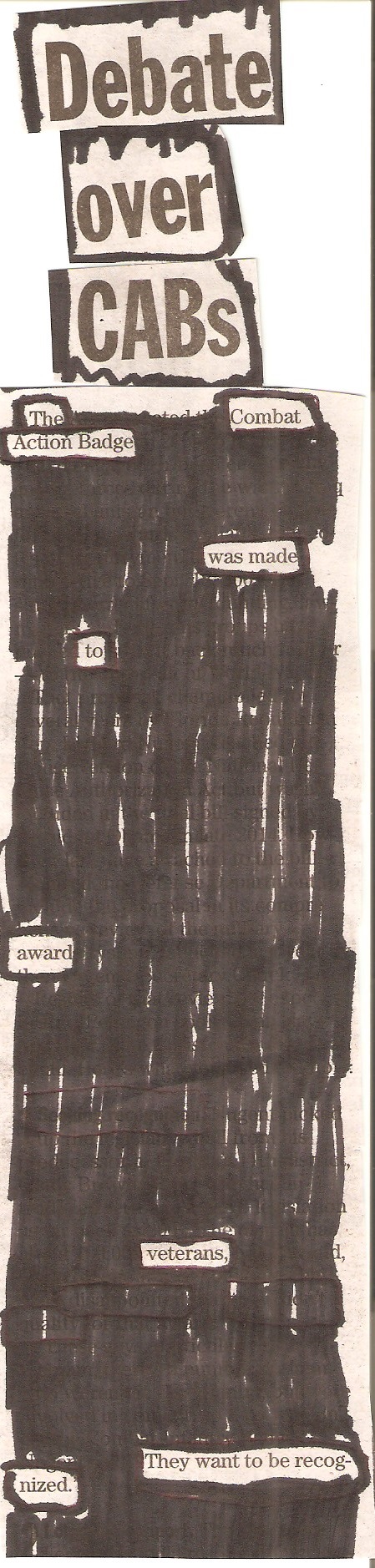
This article originally appeared in the Army Times and was over whether or not Combat Action Badge’s (CAB’s) should be retroactively awarded to soldiers.

“We don’t fight wars for awards.”

Here’s my take: Back when I was in the army, and serving in Iraq, I was awarded a CAB while serving in Mosul, Iraq. Now, at the time, CAB’s were a huge thing. Everyone wanted one. Some people wanted CAB’s so bad that they were even willing to lie to get them and “pretend,” as though they had been in a direct combat situation. It was a sad, sickening, spectacle. Several of my commanders lied about being in combat (and then backed up one another’s stories) just so they could get the coveted “Combat Action Badge.” This, ultimately, led myself and several fellow soldiers to come up with the saying “Never trust a soldier with a chest full of metal, unless the metal is shrapnel.” Lying was so prevalent that towards the end, the CAB, and several other awards, meant nothing to us.

People were trying so hard to get CAB’s that they were petitioning the Army, even back then, to change the regulations. Some soldiers wanted CAB’s for being around unexploded ordnance (I kid you not) others wanted unit-wide CAB’s since some of us had been in combat (that is actually too ridiculous for me to be able to explain in a blog post). And the coup de grace of all this is that at the end of my deployment, several fellow soldiers wanted me to lie about the events of an attack so that another soldier could be awarded a CAB. I refused, and the soldiers got upset with me, as though I was the asshole.

Anyway, if you can’t tell by now, I have no respect for soldiers, or anyone else, who feels the need to bitch, complain, and whine that they don’t have enough awards to pin on their chests.

We don’t fight wars for awards. Act like it!

 Poem Transcription:

Debate

Over

CABs

The Combat Action Badge

Was made to

Award Veterans

They want to be recognized

 For more military/war related blackout poetry click here.

To read more about the military experience and CAB’s check out the following book:

Self Improvement / Healthy Living, Self Improvement / Healthy Living

5 Rules for Vegan Camping

vegan campingThe five things you need to keep in mind while camping as a vegan.

As the days finally grow cooler, and the trees begin to change, there’s no better time to go camping then in late August or September. And there’s no better place to go camping then right here in New England. From the Berkshires of Massachusetts and the campgrounds of Rhode Island to the mountains of New Hampshire, boundless woods of Maine, and tranquil ponds of Vermont. Finding a place to go camping in New England isn’t the hard part, the hard part is being able to have that authentic camping experience, while still keeping it vegan.

Through all my years of camping and going from carnivore to vegan, my hunting knife has now been replace by a tofu press, my fishing pole by a portable blender, and my reserve of hotdogs—for when I didn’t catch any fish, which I usually didn’t—replaced by Seitan beef. When I went camping this year, though, I knew that I wanted to go back to just the basics. I didn’t want to worry about bringing extra batteries for the blender or that special grill and tinfoil for the tofu; I want just man, nature, and food. And luckily, for just a couple of bills, I was able to reserve a campsite for a long weekend. With two fellow vegans, I headed into the wilderness of New Hampshire.

The following tips—learned from experiences, and fellow vegan campers—will not only help you preserve your veganess while having an authentic camping experience, but will also help preserve the campgrounds so that you can return year after year.

1. Bugs: It’s debatable, but most vegans are against killing bugs; especially for no reason, other than they’re annoying. During one camping trip last fall, a friend had brought with him one of those two hundred foot area bug bombs. The thing was crazy. The mushroom cloud it created reminded me of the bombs I’d seen exploding in Iraq. Not only was this thing killing every mosquito within a two hundred foot radius, but it was killing every bug in the area, and it certainly wasn’t helping the birds, or any other animals who breathed it in—namely, me.

Bug bombs, if you don’t already know, are not the best option. Any type of spray, whether it’s a bug bomb, or typical repellant spray, is not good for the environment or the animals in that environment. If you’re going to use a bug repellant, then the best option is a lotion rather than a spray, as fewer toxins are released into the air for birds and animals to breathe in. However, if you’ve got something against even lotion bug repellants, chemicals and all; you could always use the army method and just break the tops off a pack of matches and swallow those to keep the bugs away—it’s not recommended. The best option, though, besides bug repellant lotions, and swallowing matches, is to start a campfire.

2. Building a fire: It’s not camping without a campfire, plain and simple. There needs to be a place to tell ghost stories, sip beer, and listen to your friend play the same song on his guitar—over, and over, and over, again. When building a campfire, though, there’s more to it than meets the eye. A good campfire should have as minimal impact on the environment as possible, and it should leave no trace after you’re gone. To do this, you need to follow three simple rules:

  • Most campers tend to make their fires too large. A campfire should only be large enough to cook your food on and gather around. A two foot by two foot campfire is more than large enough to cook food for three to four people and the smoke from it covers a large enough area to repel the bugs. When making a campfire, err on the side of too small rather than too large.
  • Only gather sticks and twigs that have already fallen, they should be no thicker than a baseball bat. Do not break branches off and do not saw through fallen logs—fallen logs are a crucial key to the habitat of a forest.
  • After you’ve made sure the fire is out, take the ash and scatter it over a large area.

3. Food: It’s not camping unless you’re cooking something over a fire, and vegans have more camp-worthy foods than most would think. My favorites are Field Roast Mexican Chipotle sausages and corn on the cob. The corn on the cob and sausages also allow for those, all too necessary, male induced camping jokes that are not possible when eating a block of tofu or drinking celery smoothies, “Good sausage, man,” “Mine’s a little bit bigger than yours,” “I like to nibble on just the tip…” Anyways, a thin stick found in the woods can easily be whittled down to a point to hold your sausage and corn over the fire.

And then let’s not forget the s’mores! I was vegan for a full YEAR before I discovered there was such a thing as vegan marshmallows. Before camping this year, I bought a big bag of them, along with several dozen dark chocolate candy bars, and a box of cinnamon graham crackers. Along with our fire-cooked sausages, corn on the cob and s’mores, all three of us felt as though it was as close to an authentic experience as possible. We didn’t miss our blenders, Vitamix’s, tofu presses or stoves, at all.

4. Hiking: Keep to the trails that are clearly marked. I know that it seems lame, and like the ‘square thing’ to do. But parks often have suggested routes and closed off areas for a reason. Whether it’s the rare birds that are nesting in the area, the turtles who’ve just laid their eggs and which you’re likely to step on, or simply that the area is damaged, the rocks could be loose and the slightest nudge by an uninformed hiker could send the whole place into a disarray killing hundreds of animals and creating a landslide. And please, if you’re vegan, do not go hiking or camping when its hunting season, it just feels too much like the set up for some crude joke to have a vegan get shot by a hunter.

5. Trash: Do not leave your trash behind! Even if you think it’s organic, “But it’s compostable, man.” Screw what you do at home; the forest isn’t the same as that crappy compost heap you keep behind the shed at your mom’s house. The forest is a self-sustaining environment and our job as good vegan campers is to leave as little impact on the landscape as possible. Take everything home!

Follow these simple rules and your next vegan camping trip will be all the more fun, and better for the environment!


Picture: Flickr/Stelluccia

Best Of, Blackout Poetry, Blogishness, ptsd, Uncategorized

Blackout Poetry: Veteran Suicides

Blackout Poetry Logo WarIn case you’re not familiar with Blackout Poetry, Blackout Poetry is the act of creating poems by blacking out words that appear in newspaper articles (or books, but typically newspaper articles). I was inspired to give it a shot after being introduced to it by Austin Kleon. I’ve got a six month subscription to The Army Times and I’ll be experimenting with it throughout the next few months.

 —Blackout Poetry veteran suicides

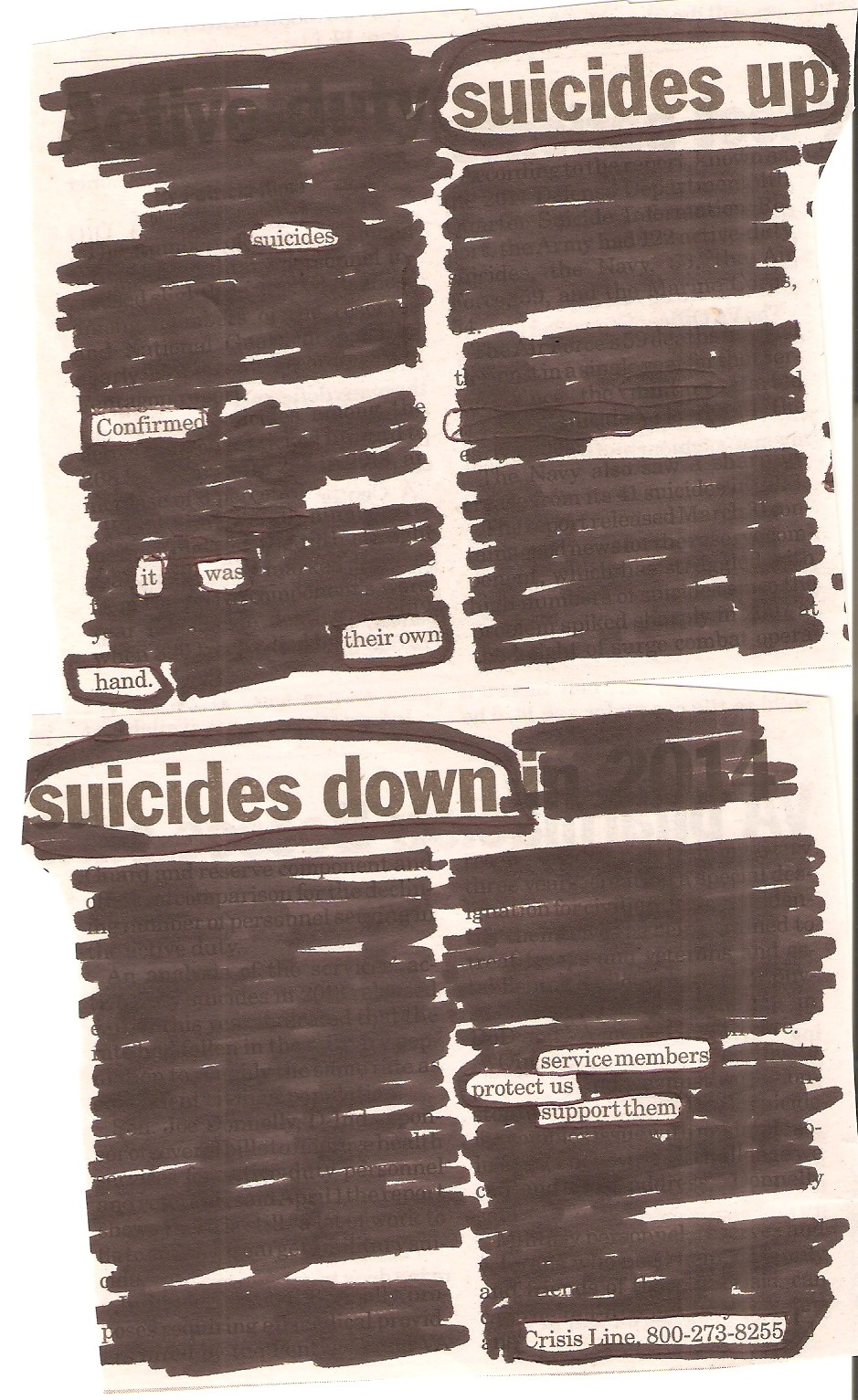
This was an article that appeared in the April 13th 2015 edition of The Army Times. The article discussed veteran suicides across active duty and reserve/national guard soldiers. In 2014 suicides decreased for active duty soldiers but increased for reserve soldiers. With 22 veterans killing themselves every day in the United States (we’ve lost two to suicide from the unit I served with in Iraq) this is a serious issue that needs to be addressed. I tried to boil down the article into its major points and through the redaction process I came up with the poem pictures above (and transcribed below).

Suicides Up

Suicides confirmed

it was their own

hand.

Suicides Down

Service members

protect us

support them.

Crisis line, 800-273-8255

 For more military/war related blackout poetry click here.

To learn more about the war-time military experience check out the following book: