Blogishness, Self Improvement / Healthy Living

Allergies: Neti Pot, EFT, Vitamin C, Local Honey and Allergen Removers

A lot of people came back from Iraq with a lot of different problems; some had PTSD, some had a TBI, and for me, I came back from Iraq and had allergies–had never had them before, and now I get them every summer.  I’ve decided that this summer I’m really going to get to the bottom of the problem and see if I can solve it naturally.  I’ve been researching for weeks and have researched about every natural way to deal with allergies.  Here’s the list that I’ve came up with.

Eat local honey–since the bees pollinate the flowers, etc, eating local honey is suppose to help with pollen allergies.

Eat 1000mg of Vitamin C, a day,–suppose to help the immune system.

Buy an Allergen Remover (air purifier) –for people who spend a lot of time indoors, indoor air is suppose to be 200% worse then the air outside and a nice air purifier can get rid of most toxins, pollens, dust mites, etc.

[I bought a Holmes Allergen Remover today, it claims to get rid of 99.7% of all toxins, molds, pollens and dust mites, etc.]

Use a Neti Pot–this is basically a tea pot that you fill up with a saline and then pour through your nose, (it’s suppose to clean up  your sinuses and people have been using it for 2,000 years in India).–I bought one of these today, too.

EFT (Emotional Freedom Technique)–this is pretty much just a type of acupuncture, but it supposedly works in a large percentage of people.  (I have a meeting on Friday to give it a try.)

And then, if all else fails, I bought some Allegra Allergy and some Zyrtec–I was using Claritin, but that has since stopped working.

I’ve got my new Air Purifier, I bought some Vitamin C (and E) I’ve got my Neti Pot and I have my appointment for EFT on Friday (haven’t found any local honey yet,) and I’ll let you guys know how it works!

Related Post: Update on the Allergy Situation and What Worked and What Didn’t Work.


Michael Anthony is an Iraq War Veteran and is the Author of: Mass Casualties: A Young Medic’s True Story of Death, Destruction, and Dishonor in Iraq.

Self Improvement / Healthy Living

Military Focus: Lessons from the operating room

u.s. medical tanks“It is better to do one thing 100%, than it is to do a hundred things 1%.” – Mr. Gilrein (My 7th grade health teacher)

I was an operating room technician for six years, and when watching a surgeon conduct surgery, there’s no doubt what’s on his mind: Surgery.  Too often it seems that people have a million things going, and instead of doing one thing, they almost do a thousand things.  But to accomplish anything in life, a person needs to be focused.

Imagine going to a restaurant and ordering pasta.  Then right before the pasta comes, you change your mind and order miso soup.  Then right before the miso soup comes, you change your mind and order smoked salmon.  Meanwhile, you keep changing your order, and you’re sitting there for an hour complaining that you’re starving and the service is horrible because it’s taking forever to get your food.

This is what happens when we don’t focus.  We change our minds, we focus on too many things, and we don’t end up getting what we want, or we end up doubting ourselves.  “I should have ordered the tuna, or the steak,” etc.

A person needs to have laser beam focus.  Think of a magnifying glass and imagine how, if left in the sunlight, a magnifying glass can focus the rays of the sun and start a fire.  A person’s focus needs to be like that laser beam, and focused on only one target.  If you go outside, on a sunny day, and hold a magnifying glass up and aim it at a leaf, if you wait long enough, the leaf will burst into flames.  But if you only do it for a few minutes, and then become bored and move the magnifying glass away, then nothing will happen, you will have just wasted your times.  We need to be able to focus until we can light the world, and our ideas on fire.

When I started to write my first book, I decided to be focused on just that.  Instead of getting a part time job, I decided to use the money I saved from my deployment and give myself the freedom to write and follow my dream. And since I wasn’t working and had no money coming in, I was on a very low budget, there were many weeks and months, where I was on such a tight budget that peanut-butter and jelly was breakfast, lunch, and dinner.  But almost a year later, to the date, of me deciding to focus on a memoir of my time in Iraq, I had a book deal, and I became the youngest war veteran author in the entire United States.

So the main thing I learned from being in the Operating Room, and from writing my first book, is that to save lives, and to accomplish great things, it’s best to focus on only one thing at a time.


Related Posts:

What the Military Teaches About Self-Discipline.

How to Build Your Self-Discipline.

I will Never Accept Defeat.  I Will Never Quit.

Military Time Management: CARVER System.

Target VS Mission: Smaller Goals VS Larger Goals.

Best Of, Self Improvement / Healthy Living, Self Improvement / Healthy Living

Veteran Wellness and The War Within – Guest Post – Part 1

Your tour of duty is over.  You march off the airplane after the long trip home, conscious of the different looks your uniform receives.  Most are ones of appreciation.  Simple nods or even out right thanks given by strangers who try to stand a bit straighter when addressing you.  Others are thinly veiled looks of disgust, and you’re not sure if it’s you or your uniform they cannot stand.  But at least it’s some sort of acknowledgement—a sign that the past eighteen months were real.  The worst are the people who don’t even seem to see you.  Rushing past you on errands, they bark orders on cell phones while drinking mocha lattes from Starbucks.  Some sit at restaurants gorging themselves in front of the flat screens which hang on the walls.  CNN is the station.  But the diners only put their forks down when the stats from last night’s game are read by the announcer.  And as you take those first steps back into your hometown, the haughty ignorance of your sacrifices makes you hotter than the Iraqi sun.

The war has just begun.

You’ve dedicated your entire life to protecting your country.  But now it’s time to protect your self.  Remember what the flight attendant said right before you took off—put your mask on first before helping others.  You outrank her, perhaps.  Yet her command is one which, if ignored, could cost you.  Just like it has cost thousands of veterans.  From suicide to Post Traumatic Stress Disorder (PTSD), the fight continues long after you leave the battlefield.  And if you want to come out of this war alive, you better stand at attention.  Health is a General who grants no leave.

First in the Veteran Code of Health is Thinking.  The average person has 60,000-70,000 thoughts everyday, most of which are negative.  For military personnel returning home, it can be even worse.  The transition back into normal life is rarely easy.  The constant threat of death is now thousands of miles away, but the nervous system is still on high alert.  This continuous stimulation of what’s called the Sympathetic Nervous System (SNS) keeps one in a state of fight or flight and keeps the Parasympathetic Nervous System (PNS) inhibited.  The PNS is in charge of repair and digestion.  Thus, over- activation of the SNS eventually degrades a person’s physical health.  This inability to recover due to simply living too much in the mind is a critical example of how the physical is connected to the mental.

But we are the commanders of these thoughts, all of which have an etiology in either Love or Fear.  Fear is nothing but False Evidence Appearing Real, and it can only survive in the future.  The past is the home of guilt and regret.  Closely related to Fear, these emotions cannot exist in the Now either.  Living in the Now makes Fear impotent, leaving only Love to guide our thoughts.  Living in the Now also allows us to realize our full potential since it is only at this moment that we can do anything.   However, most of us have been indoctrinated into the concepts of linear time such that living in the Now is almost not tangible.  Thankfully, authors such as Eckhart Tolle, Paul Brenner, and others have written extensively on how to truly become a Master of the Moment.

Breathing is next in the Veteran Code of Health.  The healthy human body can survive weeks without food and days without water, but we can only last a few minutes without oxygen.  Intimately connected to thoughts, a person’s respiration rate increases when under stress.  Whether it be from a fire fight on the field of battle or an argument in the kitchen with the spouse, stress is stress and will usually cause a person to breathe faster.  Thus, one of the ways to unwind the system and decrease levels of stress in the body is to practice control of one’s breathing and to slow respiration down.

To learn this essential skill, a person would lie down on their back with one hand on the chest and one hand on the belly. One then takes a big, diaphramatic breath in through the nose. The hand on the belly should rise for the first two-thirds of the breath while the hand on the chest should only move during the last third of the inhalation. Exhalations can occur through either the mouth or the nose before repeating the process, noting how the body relaxes with each breath.

Proficiency with this technique is vital as the average person breathes 25,900 times a day.  And since the body is only designed to breathe through the mouth when under stress, faulty breathing mechanics can literally create negative thought patterns and cause a vicious cycle of stress hormones to circulate throughout the body as the SNS continually runs in the red.

The third concept in the Veteran Code of Health is Hydration.   Our bodies are 72% water, and every physiological task the body performs depends on both the quality and quantity available for those processes.  Dr. Batmanghelidj, author of Your Body’s Many Cries for Water, states that optimal hydration levels occur when one drinks half of his/her body weight in pounds in ounces of water each day.  So 150lb person would need to drink 75oz of water every day.  When hydration levels in the body are suboptimal, the SNS goes into action and the body cannot recuperate.  As the cellular machinery grinds to a halt, the body turns first to sugar and then to other forms of toxic stimulants in a search for nutrition to run the system.  Unfortunately, this approach only magnifies the problem as, like all the body’s biological processes, digestion and detoxification both require adequate amount of water to function properly.

The rule hydrate before you medicate can be applied to any condition the military veteran faces when returning home: lack of water in the bloodstream causes hypertension; constipation is a clear sign the body is working hard to scavenge water from any source to hydrate properly.  Even the problems of PTSD are exacerbated by an insufficiency of water as additional stress taxes the system.  Yet, these neurological signs which often get misdiagnosed as depression or other “mental illnesses” are often a signal the body is severely dehydrated.  The effects are insidious and commonly ignored until they manifest as symptoms for a particular “condition.”  But the brain is 85% water.  Thus, like a plum slowly turning into a prune, the result of prolonged dehydration on the neurological system can eventually be catastrophic.

Part Two of Article: Click Here.

Of course, each of the concepts above has only been briefly introduced.  For a more thorough discussion on how you can take responsibility for yourself and be in control of your own health destiny, visit the author’s website at www.triumphtraining.com.


Best Of, Self Improvement / Healthy Living, Self Improvement / Healthy Living

Leadership Sanity – Guest Post

“Give us the tools, and we will finish the job.” These challenging words were spoken by Winston Churchill in a BBC radio broadcast on February 9th, 1941. As one of the great leaders of modern western civilization, Churchill reminded us that leadership is comprised of a set of tools. Although the direction a leader will take people today is different than it was during World War II, the principles used to get there remain constant.

I received a brief memo this morning from a listserv I belong to called Emerging Leaders of New York Arts, or ELNYA. A poll went around to successful CEO’s, in the nonprofit sector, asking what leadership guidelines helped maintain their sanity. As a veteran of the Air Force and graduate student in Museum Studies, each item resonated both with what I desire from a leader and my own aspirations to lead a culturally impactful organization. No matter the field, level, or size of your leadership influence, the following tools may help you develop your own leadership abilities.
A Short Menu for Leadership Sanity

1) Share the work of setting direction* -The CEOs said that they
discovered that it was the burden of carrying “direction setting” on their
own shoulders that weighed them down.  Regular staff and board “strategic
discussion” helps relieve the pressure.

2) Identify and feed the renegades* – Nonprofit leaders find they need to
support those employees who have a keen sense of the evolving community
needs – those with their ears to the ground.  They are supporting those
whose emotional energy is invested in the future and who are willing to
gently let go of the past.

3) Release the notion of “heroic” leadership* – No longer riding in on the
white horse to save the day, successful nonprofit leaders are focusing on
creating collaborative systems and making space for innovation.

4) Nurture employee autonomy- * New ideas and new approaches need to be
“seeded” at all levels.  Successful leaders are creating mechanisms to
encourage grassroots experimentation and reward thoughtful ideas and new
approaches to service.

5) Foster increased commitment to organization values* – Our new world
requires us to wrestle with the “discipline versus freedom” model of
supervision.  Successful leaders spend more time securing commitment to core
organizational values that are at the heart of the work we do in our
communities and with our clients.

The practice of these tools is meant to merge the latent abilities of a leader with the hard work required for success. Whether it is in the major international conflicts of our day or the daily challenges of our own private worlds, an ability to inspire and lead others towards the common good is the responsibility of every individual.

This is a guest post from Blake Ruehrwein.  Blake is a veteran of the United States Air Force with a graduate degree in Museum Studies.

Audio, Best Of, Blogishness, Blogishness, Self Improvement / Healthy Living, Self Improvement / Healthy Living

Landmark Education Forum: A Thorough Review

landmark forum reviewAnyone who’s heard of Landmark Education knows they’re an organization clouded in controversy.  There have been rumors of everything from it being the best personal development program ever, to being a cult.  I’d read all the reviews of the program and even watched a documentary about the original founder of Landmark (EST) Werner Erhard.  After it was all said and done, I was too skeptical about Landmark to do the program…then Time Magazine and BusinessWeek (within a few weeks of one another) had reviews about Landmark and what a great program it was—both articles praised it as a great program for business people.  At that point, I decided to give it a go.  I figured, best case scenario, I would go to Landmark and it would be the best personal development program ever, worst case scenario, if it was a cult, I could at least infiltrate it and write a good story about what a cult it is.

I was initially planning on doing a different blog post with a review of each day; however, after the program, a thorough review of each day is unwarranted.

Day 1:

First off: I am utterly convinced that anyone who thinks that Landmark Education is a cult, is an idiot; it is a personal development program, and from day one to day three, it’s clear that that’s all it is.  It’s just a program to help people deal with their issues.

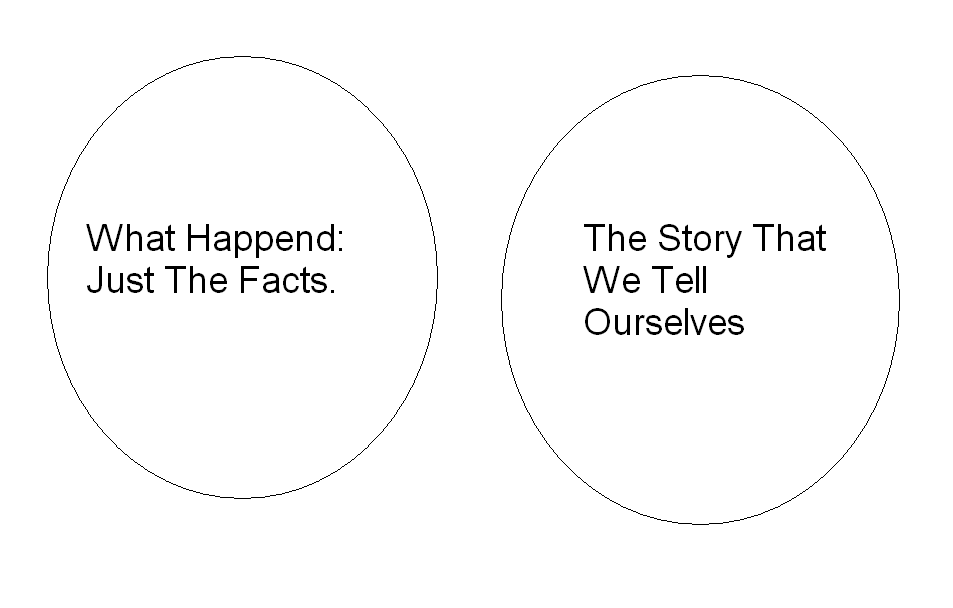
Day one can be summarized as: What Happened VS Perception: The Stories that we Tell ourselves(Pictures below).

landmark forum honest review

Certain events happen in a person’s life and they attach a story to these events.  The facts of the situation are what happened, and the story about why what happened, happened, is our perception.  The main point to note is that perception isn’t fact, its perception.

Example:

You’re on your way to work and your car breaks down.  You arrive to work five minutes late and your boss starts yelling at you, “You’re late.  You’re always late.  You’re a horrible employee.”

This upsets you and you start telling yourself what a jerk you boss is, and you tell yourself that he must hate you.

The story that we tell ourselves is “he’s a jerk,” “he hates me,” but those aren’t facts, they’re perceptions, they’re stories that we tell ourselves.  We only say “he’s a jerk,” because he did or said something that made us associate him as a jerk.  Is it a fact that he’s a jerk?  NO, it’s not a fact.  But the story that we tell ourselves is that he’s a jerk and we accept it as a fact.  We then go around complain to anyone who will listen and say, “my boss is a jerk.”  And of course telling yourself  that your boss is a jerk and treating him like he’s one and complain all day and telling yourself all day that he’s a jerk, is going to put you in a pretty crummy mood.

So when something happens, just ask yourself why you’re telling yourself the story that you’re telling yourself—and ask yourself if it’s a fact, or a story.

Day 2:

Day two started off with people talking about the breakthroughs they’d had since day one.  (A LOT of people actually had a LOT of breakthroughs in that twenty-four hour period.)  The first few hours of day two was a combinations of people talking about their breakthroughs and Landmark pushing its other products.

After Landmark selling its other programs and after the breakthroughs , they started talking about responsibility:  Personal Responsibility.  Basically it’s the aspect of a person taking responsibility for their lives and what happen in their lives.

Example:

If someone’s an alcoholic, what happens is they’ll often say to themselves, “It’s not my fault.  I only drink because my dad drank…or my dad beat me.  If he never beat me, I wouldn’t be an alcoholic.”

A lot of people had a lot of problems with day two.  They didn’t like the idea of having to stop blaming other people, and start taking responsibility for themselves.  No one’s father made they become an alcoholic.

It reminds me of the old story of twin brothers.  These twin brothers had a very abuse and alcoholic father.  Their dad used to beat them, neglect them, etc.  Both of the boys grew up.  One of them became a very successful businessman who used his riches to help other people in abusive relationships.  The other grew up to become a drug addict and alcoholic.  When the first twin (the successful one) was asked what motivated him to work so hard to succeed and then give back to charity, he responded, “Well, growing up with an alcoholic father who beat me, how could I not work hard to leave home and become a success, and then use my money to help others.”  When the other brother was interviewed (the drug addict and alcoholic) and was asked why he became a drug addict and alcoholic, he responded, “Well, growing up with an alcoholic father who beat me, how could I not become a drug addict and alcoholic.”

Same situation, different stories they told themselves.  One brother used his upbringing to drive him to succeed and the other brother used his upbringing as an excuse to blame his father for all his short coming and problems.

Day 3:

Day three started off with a LOT more selling of other Landmark programs.  Day three was also the day that was supposed to bring day one and day two together.  After all the promoting of Landmark’s other programs, the beginning of day three was, again, about people talking about the breakthrough’s that they’d had in the past forty-eight hours—there were a lot of breakthrough’s, and a lot of crying.

I can’t go into detail about all the breakthrough that people had (because we all agreed to keep things confidential) but people had breakthrough is every walk of life, from people going through divorces, people who were abused as children, people who lost their job, people who hadn’t spoken to a family member in twenty years.  There was a little bit of everything and they all benefited.

Day three was about living a life where we’re aware of the stories that we tell ourselves, and it was about living a life where we all take personal responsibility for our actions and our emotions and feelings.   Imagine a world where people didn’t fret about the “stories” that we tell ourselves and instead only dealt with the facts of a situation.  Imagine a world where people take personal responsibility for their actions.  Day three was all about perpetuating this in our lives.

The Positive: Landmark gave people an opportunity to look at their issues from a different point of view.  It gave people an opportunity to see whether the stories that they’re telling themselves are true or are just “stories.”  It gave people an opportunity to take responsibility of their lives—for the good stuff, and the bad.  A fast majority of the people who went to Landmark seemed to get something out of the training, although some people’s nuggets of gold were substantially larger then other people’s.

The negative: If you have a serious issue in your life that you need to get worked out, Landmark is the company for you.  If you’ve got a drinking or drug problem, Landmark is for you.  If you have an issue with your mother or father, or a brother or sister, Landmark is for you.  If you’re going through a divorce, Landmark is for you.   If someone important in your life passed away, Landmark is for you.

If you don’t have any serious issues: Landmark might not be for you, yet.  Yeah, you’ll get something from the program, everyone does, but if you don’t have any serious issues or problems, Landmark might not be right for you—at this time in your life—and might come across as a waste of time and money.  But if you do have a serious problem, Landmark Education is the place to go and it’ll change your life for the better.

For more information on the Landmark Forum, the following book is the best on the market. It details what Landmark forum is, from its founding, to what it’s become. It’s written by Luke Rhinehart, with a forward by Werner Erhard, and an introduction by Joe Vitale (bit redundant with an introduction, and a foreword, but still, it’s an interesting book).


Self Improvement / Healthy Living, Self Improvement / Healthy Living

Going Raw Vegan Update

At the beginning of March, I was celebrating Spring Break and had decided to become a raw food vegan .  Well, it’s thirty days later, and I’ve decided to give up being a raw food vegan, but it was a great worthwhile experience.

Anyone who is a vegan/vegetarian knows that the no-meat lifestyle has its benefits and pitfalls.  Raw veganism is no different.  There was good and bad.

The Good: For starters, more energy.  Waking up with a cup of coffee  is nothing compared to waking up with a fresh smoothie.

Typically, for breakfast, I’d have a quick bowl of oatmeal, toast, and a glass of orange juice.  But as a raw food vegan, my breakfast consisted of only a smoothie, a plate of celery, and raw peanut-butter.

And I’m not saying that my typical breakfast of oatmeal, toast and orange juice weighed me down, but it’s nothing compared to the kick with my new raw breakfast.  I had energy throughout the day and could easily skip lunch if I had to.  (I think it was the food that made the difference, though, and not whether or not it was cooked.  But, I guess, to test that theory, I should eat my usual cooked peanut-butter instead and see if that makes a difference.)

Also, one of the best things about being a raw vegan was that I saved myself plenty of time by not having to prepare any of my food.  Nothing to cook, no oven timers to check, no beeps from the microwave, just wash and eat.  This also meant that I had less dishes to wash which also saved me time.  (I would estimate that raw food veganism saved me, at least, an hour a day)

The Bad: Well, for starters, I didn’t realize that bread wasn’t considered raw.  When I thought about going raw vegan, I just figured that meant that I wouldn’t cook anything up, including vegetables, but halfway through, when my girlfriend saw me eating a peanut-butter and jelly sandwich, she reminded me that bread had been cook and thus I wasn’t being a raw food vegan.  Damn it!

But besides that, nothing bad really jumps out.  The worst thing, and the most obvious, was that the food just doesn’t taste as good.  Don’t get me wrong, I love fruits and vegetables, but celery and peanut-butter is nothing compared to a grilled veggie burger and some fried onions, they’re just two different levels.  So the food wasn’t bad, but I did miss cooked foods.

I’d recommend it to anyone who’s thinking about giving it a go.

Read Part One Of This Post: Here.

Best Of, Blogishness, Self Improvement / Healthy Living, Self Improvement / Healthy Living

How to Be a Stand up Comedian

how to be a standup comedianIt starts with an awkward silence.  All eyes are glued to you as you walk to the stage; the littlest misstep and you’ll never live it down.  The second that your foot hits the stage, you take a deep breath, sweat drips down your brow and your palms freeze.  Stepping up the microphone you exhale and tell yourself that you’ve been here before, that you’ve only got five minutes and you can handle it.  You look out over the audience; finally its time to ease the tension, theirs and yours.

The most important part of being a stand up comedian is knowing your story: where you’re from, your background, how you were brought up, and what makes you unique.  Every detail helps the audience to identify with you and lets them get a better feel for your right to tell certain jokes.  To be a comedian you’ve got to know yourself, and you’ve got to then be able to laugh at yourself.  As one struggling comedian put it: “You don’t want to hear a rich guy talking about being poor, so why would you listen to a comic say jokes about something he never went through…stick with what you know.”

The first thing after stepping on stage is adjusting the microphone.  Is it too tall, too small, do you prefer to hold it in your hand and walk around?  I don’t.  I stand still and speak. “So…I was in the Army, and I just got back from Iraq a little while ago.” A few people usually applaud.  I’ve got their admiration and respect but not their laughter.   “And before I go on…I know there’s one question on everyone’s mind…and NO…I did not vote for Scott Brown.”  There’s a few laughs in the back of the club, it’s an inside joke and it usually only gets a laugh from the military people, but nothing too serious.  That’s ok though, you’re not supposed to start off with your strongest material.

[The comedian format goes like this:  Introduction: let them know who you are.   Feelers: toss a few jokes out there and get a feel for the audience and what you can get away with.  Builders: you begin to really get into your routine, you start with a few low-key jokes that you’ve used before and that you know will work.  New Material: if there’s any new jokes you want to try out, you try it out right after or during your builder jokes.  Main Material: these are the jokes that you’ve used dozens of times and always get laughs.  End: leave them on a high-note, your funniest joke.]

“Everyone thinks that because I’m a vet, that I voted for Scott Brown because he was in the Army National Guard for thirty years…but let me tell you about Scott Brown…”  Comedy is like writing, you need to know your audience.  Jokes about a senator from Massachusetts aren’t as funny in Rhode Island, as they are in Massachusetts.  A good tell for your joke is whether or not you have to explain any part of it to the audience.

“Scott Brown was in the Military for thirty years, during three wars, and a dozen major military operations, and he’s never gotten deployed once.  The only time he’s been overseas is when he got sent to Paraguay for two weeks.   Yeah, I know some vets that have been to Paraguay for two weeks….it’s called vacation.”  There’s the joke build up.  Every joke needs a beginning, middle, and end.  A joke should start off with a little bit of story, then a small joke, and then BAM the main joke.  The audience should never see it coming.  It’s the amateurs who go out there and pound out one-liner after one-liner.

“Scott Brown tried to get a Purple Heart for getting sunburn while at the beach in Paraguay.  I mean seriously, the only PTSD flashbacks that Scott Brown has is from when he watched the movie Saving Private Ryan in high def.”

The audience is silent.  No laughter.  Luckily the Army taught me the axiom “Improvise.  Adapt.  Overcome.”  Political jokes and military jokes can either be hit or miss; most people haven’t been in the military and even fewer have actually fought in a war.   In this situation, most comics revert back to the universal routine, the routine that fits every audience: relationship humor.   Most relationship jokes, no-matter-what, will get laughter.  No matter how bad or ridiculous they are, someone in the audience always knows what you’re talking about.  And after a stock joke or two about relationships, it’s time to bring out some of the new material and test it out.

“I’ll tell you though, before I went to Iraq I was dating this girl and, like, have any guys here dated a woman with a really strong personality?”  A few men raise their hands and then look at their dates and laugh, “my last girl friend had this really strong personality and I loved it, you know, she knew what she wanted and I always knew what I was getting with her.  But anyways, we eventually broke up and now I’m dating a new girl, and she doesn’t really have a strong personality…but she makes up for it by having three or four different ones…”  Since it’s a new joke, this is where you pause and take note of the audience’s reaction:  How long did it take them to laugh after the punch line?  How hard did they laugh?  Are more men or women laughing?

The MC from the back waves his hand which usually indicates only two minutes left.  The problem with a routine is finding the right spot between saying too much and saying too little.  You don’t want to go on stage and say ten minutes of relationship jokes, or ten minutes of jokes about politics.  You want to change it up and give a variety, but also, you don’t want to be jumping around and saying ten jokes about ten different subjects and have none of them tie together.

“Have you guys ever heard the saying that, ‘if there were a million monkey’s randomly typing on a million different typewriters, that they’d eventually type the completed works of William Shakespeare?’”  Pauses are a fine key to comedy.  It’s like the silence in-between musical beats, and the punctuation in writing.  You need to give the audience a brief moment of reflection before you hit them with the next beat, sentence, or joke.  “Well, I had a math teacher tell me this once, and I decided to start an experiment to see if it were really true, that a million monkey’s typing on computers would end up typing Shakespeare…so a few years ago, I start the experiment by inventing blogs…”

Not everything in comedy always works.  But it’s like writing.  You’ve got to know your audience, you’ve got to know your material, and most importantly, you’ve got to revise, revise, revise, and revise.

[tube]http://www.youtube.com/watch?v=TuN9-WRJjJU[/tube]


Best Of, Self Improvement / Healthy Living, Self Improvement / Healthy Living

Top Five Mistakes Made on Resumes: How to Correct Them

Today we have a special guest post from Human Resources Manager and former Marine: Chandler Ruehrwein.

Top Five Mistakes Made on Resumes: How to Correct Them

As a Human Resources professional I see hundreds of resumes for each position that opens up.   I then weed those resumes down to just a few which I will invite in for an interview.  How I narrow it down to those few interview worthy resumes is an excellent question.  The answer is between a combination of the recruiting department and the hiring manager.  I could see a stellar looking resume and send it over to the hiring manager with a little extra note; “looks really interesting.”  Or if the resume is not perfect I could simply send it over.  Below are some common resume mistakes.

1.       Not including language from the job description.  If you know how to do the job that you are applying to; than say it in your resume.  I want to know that you can do the job and expressing it in your resume is the best way.  Note:  Literally use trade language and language from the job posting.

2.      Lack of Contact information.  Always have an email address.  Use an email account that you are going to check.  Don’t use a college email account that might shutoff 6 months after you graduate.  Don’t use an email account that has a high spam filter and if someone responds you never receive the message because it went into your junk folder.  Pokerplayer4586@aol.com might not be the most professional email address but definitely use it if you’re applying to the World Poker Tour.  Put your phone number on the resume.  Put your home and cell.  You want the recruiter to contact you so provide them with every possible avenue.

3.      Too much information.  One or two hobbies are great.  If you state your hobbies in a volunteer section that is great too.  Employers do not want to know if you’re married, your age, or any personal information.  Many recruiters consider this information to be personal and they do not want to risk discriminatory practices.  Just leave the information out.

4.      Watch your  grammar.  Too many commas or incorrect capitalization is not a blatant error.  However miss spelling a word, poor word choice, or just plain grade school writing will not compliment a resume.  Spend some time fixing the resume up and making it look professional, choose your words wisely, and present a nice, clean, concise resume.

5.      Lack of Cover letter.  90% of the time, submit a cover letter.   A rare 10% of companies specifically do not allow a cover letter.  The cover letter allows you to build on your resume and build off the job posting.  It also helps you explain why you want to work for the company.

Each one of these tips is designed to continue the advancement of your resume.  In many cases, your resume might have stopped along the process, and it just sat on someone’s desk.  Eliminating these common errors from your resume will help you become one of the interviewees.

Stay tuned for the next update…

Audio, Best Of, Self Improvement / Healthy Living, Self Improvement / Healthy Living

How to Build Your Self Discipline

military self disciplineSelf Discipline: Self Discipline is a person’s ability to get done, what they say they’ll get done.  If a person says that they’re going to wake up at 7:00am, then they get up at 7:00am—not 7:01, 7:02 or 7:03.

Like most things in life to get better at a skill, you’ve got to practice.  And since Self Discipline is a skill that can be learned, that means it’s a skill that needs to be practiced.  The more a person practices self discipline, the more disciplined they become, the less practice, the less disciplined.  Everyone has different levels of self discipline; if a person can look at a piece of chocolate cake, and if they can wait, even one second, between wanting to devour the cake, and actually doing so, then they have self discipline.  Some people can look at the cake, want to eat it, and not eat it.  They have stronger self discipline.  There are just different levels, and most people fall somewhere in-between.  The great thing, though, is that if anyone wants to improve their self discipline, it’s actually pretty easy.

(1)   The first step to building self discipline is to gauge where you’re current levels are.  Take a moment to think of areas where you are disciplined; then take a moment to look at areas where you’re not discipline.  Rate yourself on a 1-10 scale, and if you’re honest, you’ll have a good gauge of where your discipline is currently at.

(2)   Once you know your level, it’s time to give yourself a test.  It’s best to start easy.  Too many people, when starting to build self discipline, they will pick some huge outrageous goal.  For example: someone might say “I want to develop discipline to run five miles every day.”  They’ll motivate themselves, and pump themselves up, then on the first day they’ll run four miles, pull a hamstring, say it’s too hard, and give up.  Blah!

a.       If a person’s goal is to eventually be discipline enough to run five miles a day, then they need to build up their self discipline progressively.  If someone’s not a runner, first they’ll need to build up the discipline to walk five miles a day.  If someone can’t walk five miles, then there’s no way that they can run five miles.  For some people they might need to start even smaller and start off walking just one mile a day, then two, then three, then four, then five, then running a mile and walking four, then running two miles and walking three, etc.

b.      The same thing goes for time, as well.  If someone wants to run or walk every day, then they might want to first start off committing to walking or running three times a week, and see if they can accomplish that.  Then if they can do that, move on to four times a week, then five, then six, etc.

(3)   Once you start to build up your self discipline and can get to a certain level, it’s always important to try to branch out and either make yourself more disciplined or become disciplined in a new field.  If you’re running/walking five miles a day but are still eating two bags of cookies a day, then it might be time to start to build up your dietary discipline.

(4)   Repeat steps 1-3 until you’ve developed adequate amounts of discipline in all steps of your life.

(5)   Don’t become too disciplined.  I’ve heard too many stories of people who become so disciplined that they allow their ‘disciplined habits’ to run their lives.    There was one guy I knew in the Army who was extremely discipline.  He would wake up every day at 5:00am.  He would run two miles, do a hundred jumping jacks, and a hundred push ups.  He’d then shower for exactly 10 minutes.  Eat a healthy breakfast of a banana and oatmeal, back a nice protein shake for lunch, and then head off to work.  That was his day, every day, for the past ten years that he’d been in the Army.  The guy was one of the most tightly wound lunatics I had ever met.  He was so disciplined that he had no idea who to just let go, and stray from his daily routines.  He wouldn’t go out with friends because he had to be in bed at exactly 9:30 pm so that he could wake up at 5:00am.  He wouldn’t go out to eat because no restaurants could meet his strict dietary disciplined standards.  The stories go on and on.  He was a time-bombing waiting to go off.  So make sure to build your discipline, but don’t take things too far.

Self discipline won’t come easy, but that’s the beauty of it.  If it did come easy, then it would be called discipline.

Some of my favorite quotes on self-discipline:

“We all have dreams. But in order to make dreams into reality, it takes an awful lot of determination, dedication, self-discipline, and effort.” –Jesse Owens

“Mental toughness is many things and rather difficult to explain. Its qualities are sacrifice and self-denial. Also, most importantly, it is combined with a perfectly disciplined will that refuses to give in. It’s a state of mind-you could call it character in action.”— Vince Lombardi
“Ultimately, the only power to which man should aspire is that which he exercises over himself.” –Elie Wiesel

“Nothing is more harmful to the service, than the neglect of discipline; for that discipline, more than numbers, gives one army superiority over another.”—George Washington

Related Posts:

What the Military Teaches About Self-Discipline

I will Never Accept Defeat.  I Will Never Quit.

Military Time Management: CARVER System

Target VS Mission: Smaller Goals VS Larger Goals

Best Of, Self Improvement / Healthy Living, Self Improvement / Healthy Living

What the Military Teaches About Self Discipline

How to develop military self disciplineWhen a person joins the military, his first taste of discipline is external. His drill sergeants assume that he has no self discipline and thus seek to install it;  left to his own devices, the soldier, sailor, or airman would be slovenly and too self absorbed to succeed.

Had the new recruit chosen another life, college or a civilian job, his time away from the classroom or the shop would have been his own. He could have decided on his own when to get up, when to study and what to do after hours. No one would have spoken to him about the shine on his shoes and the length of his hair.

This is not to say that the young civilian would not find discipline in his life. He would also be growing as a person and realizing that he must please his boss or his teacher if he ever wanted to succeed. However, his path to maturity can be slower. The military man has gone into a demanding profession. His country depends on him for its very survival. He is going to be asked to risk or give his life for his fellow soldiers and for the nation. He has to grow up fast and be ready to do things that lesser men cannot.

So his first days in the military, aren’t pleasant ones. Discipline must be ground into him. He has to gain physical strength, endurance, knowledge, and spirit quickly. Day by day, morning and night, he is pushed to do more than he thinks he can. He is forced to stand tall and look sharp. He must run everywhere and never give an excuse for failure.

At first he is forced to do these things. He is watched, yelled at, and punished for every infraction. Bit by bit, though, he starts to internalize the code of the military. He starts to care if his fellow soldiers succeed or not. He starts to care about the military code. He stands tall, not because someone has told him to, but because of the pride inside him. He is fit and ready for the hard life ahead of him.

This determination and spirit does not leave the soldier when he leaves the military. He approaches tasks in the civilian world with the same self discipline that he acquired years back as a nervous young recruit. Now he is a confident individual, ready to tackle the projects that those around him fear are impossible.

He knows, first of all, the value of organization. He can put things into perspective. He sees that the impossible project is only a series of little tasks.

He learned long ago that self discipline is the first step towards leadership, and now he is ready to step to the front of the group and assign those tasks to others.

He realizes the importance of following through on a task and following up on the people assigned to it. He knows that the self discipline that rests in his breast may not be present in his non-military team mates. He is ready to lead by example or push from behind. Whatever the moment requires, he can do. He is not afraid to praise or to punish. As the job nears completion, he sees that same spirit of comradeship and pride beginning to grow the same way it did for him when the military taught him all about self discipline.

Looking for a good book on military discipline? Then check out the book “Unleash the Warrior Within,” by former Navy SEAL Richard Machowitz. It’s one of my favorites!

 Related Posts:

How to Build Your Self Discipline

Military Time Management: CARVER System

I Will Never Accept Defeat.  I Will Never Quit.

Target VS Mission: Smaller Goals VS Larger Goals