Comedy, military, ptsd, Uncategorized, Writing

Funny War Memoirs: The Importance of Humor When Telling A True War Story

War stories continue to capture the attention of today’s generation. Stories of how veterans survived each encounter they had with the enemy, how they managed to live with the limited supplies that they had, how they met and made friends not only with their comrades but also with the locals of the place where they were deployed, and how they learned more about appreciating life through their near-death experiences continue to become fascinating windows to the past and current events.

[pullquote]”Humor is a powerful and indispensable tool in keeping one’s sanity intact in the face of death and destruction.”[/pullquote]Your grandparents or any relative who had been deployed to war may have told their war story differently. You may notice that every time your grandfather tells his story, it would be filled with details of the places he has been in, the people he has encountered, the sensations of terror and waiting for death which would scare the living hell out of anyone. Sometimes, your veteran relative would focus on his achievements in the war, such as how he managed to lead his troop into enemy camp and capture it, how he killed men, and how he was considered a hero.

It may be an attempt to recall what had happened, it may have been altered to favor the storyteller’s image as a war hero, but the common theme surrounding the telling of war stories is the use of humor — its use of jokes, of anecdotes, of words which are meant to make people feel the impact of the events in the story.

Why is humor used by war veterans to tell their war stories? Being that what they are telling is their experiences in gruesome battle, which may have been traumatizing to thousands and even millions of people at the time, what would be the reason why humor would be needed to retell these tales?

War is painful. Not only does it injure people physically, imprinting lifelong marks on the skin of soldiers and civilians, but it is also emotionally and mentally stressful to the mind and spirit. Many have gone mad just by serving in the war for a few months. Civilians who have witnessed the horrors of war experienced being in the middle of conflict and being unable to do anything about it, except just to hope that they are not killed with the guns and the bombs that are going off everywhere. If explosives are not going off, people think of how to survive with limited supplies. Of course, soldiers are usually provided with food and shelter by their government in order to survive, but in the end they would still need to use their own creativity and wits just to make it through every day without starving, going mad, or becoming thoroughly exhausted.

Being in a war is one of the most painful experiences that a person can go through in life. It changes you and makes you more aware of the horrors that lie in the world. If people continue to wallow in the pain and suffering that comes with being in a war, it would be difficult to find the courage to get up from bed every day without your conscience being bothered.

Humor is a survival tool in this instance. It helps war veterans deal with the horrors and the stresses of war, and helps make it easy to retell their war experiences. Humor acts as a pain reliever which helps veterans and civilians (who can also be considered as war veterans in their own right) keep positivity in their lives, thus encouraging them to continue living their life to the fullest.

Humor is a powerful and indispensable tool in keeping one’s sanity intact in the face of death and destruction.

Just because people have gone to war and experienced it firsthand does not mean that simply being happy is something that they should be guilty about. There is no need for anyone to wallow in the miseries of war and destruction. Even in the darkest moments, people can still laugh, see the bright side of life, continue to hope, and appreciate what life has to offer.

Civilianized: A Young Veteran’s Memoir

In this dark humored War Memoir, Iraq veteran Michael Anthony discusses his return from war and how he defeated his PTSD. Civilianized is a must read for any veteran, or anyone who knows a veteran, who has returned from war and suffered through Post-Traumatic Stress Disorder (PTSD).
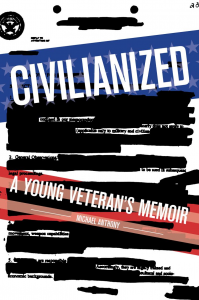
dark humored military memoir“An intense memoir.” -Kirkus

“I wont soon forget this book.” -Mary Roach

“A must read.” -Colby Buzzell

“[S]mart and mordantly funny.” –Milwaukee Journal Sentinel

“Anthony delivers a dose of reality that can awaken the mind…” Bookreporter

Order your copy of Civilianized: A Young Veteran’s Memoir .
Quote

Thought For The Day

I’m not sure when/where I first came across this quote, or who to attribute it to, but it’s been one of those quotes that have stuck with me ever since I first heard it. I think it really speaks to the idea of living the type of life that makes us feel fulfilled when we die; the goal, I believe, is that when we die, there is no one to meet, in the sense of “the person you could have become,” because we already are the person we “could have” become.

Standard, Uncategorized

How the Organization, Mission Continues, is Helping Veterans with PTSD?

PTSD or Posttraumatic Stress Disorder can be common for war veterans. Often, war veterans lose a part of themselves in battle. They often come home bruised and wounded inside even if they don’t necessarily have any physical wounds. War can destroy their emotional stability.

This is why an organization named The Mission Continues was founded. This organization aims to help war veterans find a purpose for their lives after getting into battle. Aptly named, the organization aims to aid war veterans in helping their community. The most common problem of war veterans actually involves finding a job. Most war veterans are left doing nothing at home without stable jobs. This organization makes it possible for them to be productive and help their community.

This program was actually founded by someone from battle, a former Navy Seal named Eric Greitens. He was a former Rhodes Scholar and graduated from Duke University and actually spent a lot of humanitarian work in places like Bosnia, Calcutta and Rwanda. A lot of his youth was spent in working on humanitarian support. In the long run, he joined the Navy to help the community more by offering his service.

For Greitens, however, serving is not enough. So, when he returned home and got exposed to the most common symptom of war veterans, he decided to do something about it. He thought that public service would give his fellow war veterans a new sense of purpose. So, in 2007, the Mission Continues started out their service to the community with 3 members. In 2012, the Mission Continues had approximately 500 fellows.

Veterans often come home wounded inside and out, but this programs aims to help them heal faster and still be of service to their countrymen.

Greitens know for a fact that war veterans are important even in today’s society, so he actually puts emphasis on what he thinks most war veterans want to hear from their community: “We still need you”.

Anyone can join the Mission Continues programs in various ways: Fellowship

A fellowship program is open for all post 9/11 veterans of any race, gender or branch of service. It actually involves around 20 hours of service at any non-profit organization. Fellows are even encouraged to join an organization based on things dear and near to their hearts.

To become a fellow, you must have served the US Military after the 9/11 bombing and attained an honorable discharge except when there was a sustained injury that prevented such. Also, fellows should not be on active duty, reserve or in the National Guard. Lastly, they must also have a clean criminal record.

Being a Mission Continues fellow helps war veterans with their PTSD by:

  1. Letting them connect with fellow veterans in their community and across the country. The fellowship orientation is a good example of how war veterans are acquainted with each other.
  2. Developing their skills and professional network. Fellows often plan and attend their projects with not just their fellow veterans but civilians as well.
  3. Translating their military-based skills to other skills that will be beneficial to being a part of the civilian workforce.
  4. Providing them with a cost-of-living stipend

Truly, the Mission Continues empowers war veterans in adjusting to their civilian life after their service. With this program, war veterans can find another purpose in their lives by helping the community they live in and being passionate about their work. This unique program has become successful in its endeavor because it addresses a real problem that is often left unsaid.

Its success is due to the fact that it addresses not just one problem about PTSD, but also deals with the problems of the community at large. It has produced several community leaders who are now improving the resources of the community when it comes to education and various other aspects. It is a success because it aims to make a long-term impact not just on the war veterans involved in the program but also to the community they help.

Hopefully, this movement inspires a future generation of war veterans so that they can productively integrate themselves back into society and make sustainable transformation in their own communities.

To date, they have the support of various private donors, corporate sponsorships and other foundations. From just three fellows back in 2007, The Mission Continues now has thousands of war veterans as fellows who aim to serve an entirely new mission at home. Everyone is invited to join the program by visiting their website www.missioncontinues.org.


Civilianized: A Young Veteran’s Memoir

In this dark humored War Memoir, Iraq veteran Michael Anthony discusses his return from war and how he defeated his PTSD. Civilianized is a must read for any veteran, or anyone who knows a veteran, who has returned from war and suffered through Post-Traumatic Stress Disorder (PTSD).

dark humored military memoir“An intense memoir.” -Kirkus

“I wont soon forget this book.” -Mary Roach

“A must read.” -Colby Buzzell

“[S]mart and mordantly funny.” –Milwaukee Journal Sentinel

“Anthony delivers a dose of reality that can awaken the mind…” Bookreporter

Order your copy of Civilianized: A Young Veteran’s Memoir .

Blogishness, Blogishness, Comedy

The New Impractical Jokers Card Game – Play at the bar with friends! (Pics included)

impractical jokers card gameThe show Impractical Jokers is one of the funniest things on TV right now. In case you’re not familiar, it’s a reality series where four friends Joseph “Joe” Gatto, James “Murr” Murray, Brian “Q” Quinn and Salvatore “Sal” Vulcano challenge each other to complete ridiculous pranks (which are, of course, filmed by hidden cameras).

It might not sound like much, but it’s a hilarious show. Trust me, try out a few episodes–it’s one of those shows where you need two or three before you get into it (that’s how it was explained to me and I fully agree; when I saw my first episode I was like “Yeah, this is okay,” but by episodes three and four I was hooked!)

Anyway, here’s why I’m writing about the Impractical Jokers today: Whenever I watch the show, part of the fun is imagining myself and my friends in similar situations and pulling similar pranks. This got me thinking, and as I result I invented: The Impractical Jokers Card Game!

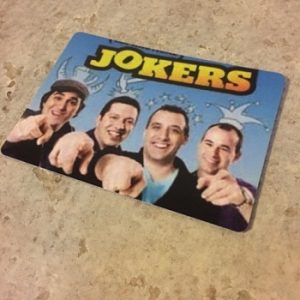
Here’s the front of the cards:impractical jokers card game

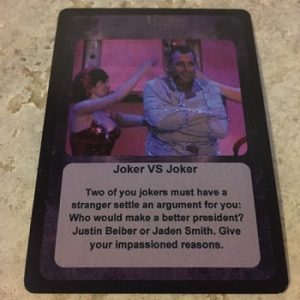
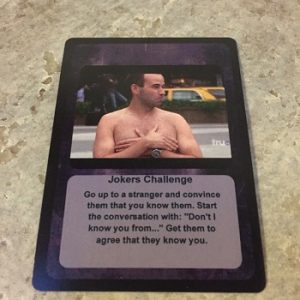
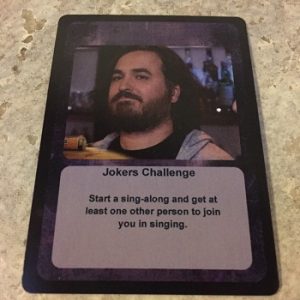
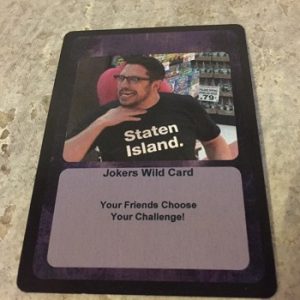
There are two sets of cards:  Challenge Cards and Punishment Cards (samples below).

How to play: You and a group of friends go to a bar (or some other public venue) and each person draws a challenge card. [The challenge cards are all based on challenges that the Jokers have done on their TV show; I tried to choose simple challenges, that the casual fan would have fun with and be able to accomplish while at a bar with friends. (Also included are Joker VS Joker Challenge Cards and Jokers Wild Cards–where your friends choose your challenge!)]impractical jokers card game joe gattoimpractical jokers card game james murr murrayimpractical jokers card game brian quinn

impractical jokers new card game sal vulcanoAfter each participant either completes or fails their challenge, all losers will then draw a punishment card (other option is that you continue with the challenge cards until there is only one loser).
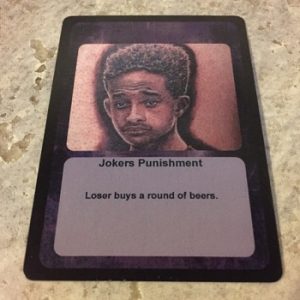
impractical jokers card game jaden smithThe punishment cards also have a different back than the challenge cards (so they can easily be told apart).
impractical jokers new card game punishment cards

The punishments are nothing like they are on the show. They’re more simple, buy a round of beers or appetizers for your friends, automatic designated driver next time you all go out, give your friends your phone and let them post a Facebook update for you, etc.

Now, here’s the deal. This is a supper fun game, I’ve played it with friends, but I’m not here to sell you the game. What I need though is your help in contacting the Jokers and convincing them to create an official Impractical Jokers Card Game. It’s hard coming up with challenges and punishments and I think we need the Jokers to add their magic touch and create a fun game that all us Impractical Jokers fans can take with us to the bar with friends.

If you want to help, just link the idea/images to the Jokers on Facebook, Instagram or Twitter, etc. Maybe it catches on, maybe it doesn’t. Just a fun idea I had and wanted to see if there was any traction.

Thanks guys!

Quote

Thought For The Day – P.G. Wodenhouse

I love this quote because I think it’s so true for most writers. Once we first picked up that pen and paper and realized this is who I am, it’s as though your life before was just a blur. Think of it as B.C. and A.D. “Before Christ,” was this part of history, and then after Christ is this other part of history. It’s true for most of us, whatever our profession. Before we became a writer/artist/entrepreneur/ life was this, but after, now it’s this.

ptsd, Self Improvement / Healthy Living

How War Can Lead To A Nihilistic Outlook On Life

nihilism and ptsd

[pullquote]”In fact, most civilians know war through a superficial lens—through what the media shows them and what other people relay to them about their experiences.”.[/pullquote]People who have seen how dark life can become eventually adapt a defensive view of their life. They reject what makes life, well, life—how people live and act against the forces of nature. When someone rejects the religious and moral principles that encompass life, they undertake what’s known as nihilism.

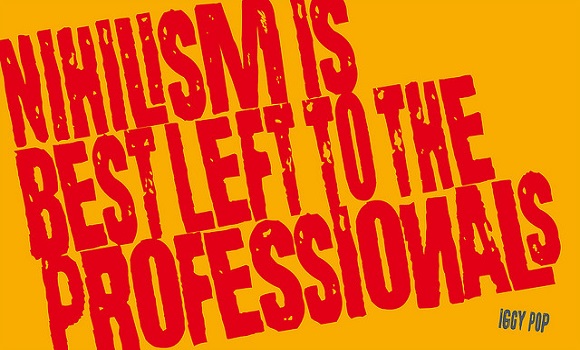
Nihilism is best known as the rejection of all moral and religious principles, in the impression that life is ultimately meaningless. The phrase originates from the Latin term, nihil, which translates to nothing. Nihilism is also used to promote the idea that life, or the world itself, has no true morals.

This philosophical position is famously associated with the German philosopher, Friedrich Nietzsche. However, his position on the philosophical belief is sometimes misunderstood. Nietzsche was one of the first philosophers to extensively study the philosophy; he also extensively discussed criticism of the belief as a whole.

He notably argued that ‘nihilism can become a false belief, leading individuals to discard any hope of meaning within the world and create some significant compensatory alternative.’ He also argued that ‘Nihilism results from valuing higher beings who don’t value earthly things.’ Lastly, Nietzsche also suggested the idea that ‘Idealism, after being rejected by the believer, could potentially lead to Nihilism.’

Why War Makes Soldiers Develop Nihilism

Popular culture tells us that war changes people. This sentiment is reflected in various quotes, depicted in countless films and recounted in just as many songs. In fact, most civilians know war through a superficial lens—through what the media shows them and what other people relay to them about their experiences.[pullquote]”It’s possible for people to overcome a nihilistic mindset, especially if they developed the mindset as a result of war.”[/pullquote]

There’s an underlying aspect to how war changes people that others don’t quite understand. War’s effect leave a lasting effect on the enlisted people who participated and the civilian people thrown into the middle. Soldiers, in particular, often end up bearing a lot of physical and emotional trauma that they don’t understand how to cope with. Due to this, many harbor feelings of resentment, fear and other negative feelings.

Some soldiers lash out in self destructive ways. This type of coping is responsible for tragically claiming the lives of soldiers each year. Fortunately, mental health organizations have made movements to help soldiers cope with their mental trauma from war.

However, some survivors choose alternative ways to cope with their trauma. Some undertake a new religion, while others adapt a new philosophy (such as Stoicism) to help themselves navigate life once more. Soldiers who cope with depression and other symptoms from post traumatic stress disorder may undertake a mindset that changes how they view life.

Emotional nihilism develops after someone has experienced significant mental and, sometimes, physical trauma. It doesn’t develop in most people who go through significant mental trauma, but soldiers of war tend to be among the most frequent suffers of this phenomenon. Soldiers who aren’t adequately prepared to cope with such situations tend to lose hope and then develop doubts about their purpose in life.

Overcoming Emotional Nihilism

It’s possible for people to overcome a nihilistic mindset, especially if they developed the mindset as a result of war. A nihilistic state of mind may be damaging to people who return home after being enlisted.

This type of mindset can completely change how a soldier sees life during their enlistment, while they’re waiting to be deployed once more and even after they’ve officially retired from service. Of course, today’s mental health societies do make sure soldiers receive adequate mental health care following their enlistment in the military. But truly breaking out of a nihilistic mindset requires the efforts of the affected person.

Some soldiers of war don’t break out of the mindset, after remaining with such thought processes for years. This mindset can make a person exhibit mental exhaustion or, in other words, develop a tendency to emotionally check out. They become disengaged from all aspects of their life, because they feel like doing anything doesn’t matter. While a nihilistic person can normally function, the things they do tend to only happen out of duty and not a real sense of fulfillment.

Soldiers who have become nihilistic after returning home do have options to overcome that mindset. Learning how to accept what has happened to them plays a large role in accomplishing that. Interestingly enough, utilizing other philosophies – such as Stoicism – may help a soldier regain their sense of self and some enthusiasm for life.

Overcoming emotional nihilism does take effort. However, a returning soldier of war can start making large steps toward recovery by accepting that whatever happens around them, no matter when it happens, occurred by means out of their control. That familiar theme, originating from Stoicism, can help a soldier accept their experiences and learn how to cope better after war.

Once people overcome nihilism, according to Nietzsche, a society can then foster a true foundation to thrive.

Picture: Flickr/brett jordan

Politics / News, ptsd, Uncategorized

Alternative PTSD Treatments

alternative therapies for PTSDContemporary Alternative PTSD Treatments…

Aside from the conventional medications and therapy sessions, war veterans suffering from PTSD can also opt to try alternative treatment to calm their mind.

Usually, contemporary treatments are used alongside with the conventional medications. A popular example of this one is the use of aromatherapy to reduce the discomfort that a patient feels after surgery. In some instances, these alternative treatments are used instead of contemporary ones; as in the case of following a special, healthy diet instead of undergoing chemotherapy.

The list below shows several effective treatments that will help reduce your anxiety and depression. Please keep in mind that you must still consult your personal physician before trying out these contemporary methods:

  1. Relaxation Techniques

These methods offer a short-term relief for anxiousness or depression. It is also used for patients with inflammatory or heart diseases. Relaxation techniques are effective for adults suffering from generalized anxiety disorder. Unlike the cognitive behavioral therapy, this one can be done at home and without the need for a therapist.

  1. Acupuncture

This is another therapy that is gaining popularity in the field of PTSD. In fact, the group Acupuncturists Without Borders offers free acupuncture treatment to war veterans. You can find these specialists in more than 25 health facilities across the United States.

Acupuncture is a great alternative for the pharmacological drugs that are commonly administered in hospitals. Aside from being affordable, this treatment does not alter one’s brain negatively and it allows soldiers to carry out their duties while undergoing conventional PTSD treatment.

  1. Yoga

This is another alternative treatment that is widely embraced by active military while undergoing PTSD treatments. The physical movements of yoga are effective at relieving pain, bringing lasting comfort, and providing adequate physical stimulation at the same time.

People who are haunted by nightmares and anxieties find it difficult to sleep at night. Even though they are not on guard duty anymore, most war veterans have an extremely vigilant nervous system.

With the right yoga and meditation techniques, PTSD patients can learn how to relax their nervous system, allowing them to have restful sleep. Yoga also gives the feeling of safety and calmness.

  1. Kava

Kava is a plant that thrives in the South Pacific region. It is commonly used for improving one’s mood and relieving anxiety in a safe manner. It can usually be bought in tablet forms. Ask your personal physician first before taking up kava tablets.

Efficacy of Alternative Medications

There is still a lot to learn when it comes to alternative medications for PTSD. Acupuncture, for instance, is proven to be effective. However, it needs to be further evaluated in order to determine its non-specific benefits.

The Department of Veterans Affairs offer evidence-based treatments. Although they do not have specific guidelines for providing alternative PTSD treatments, they are implementing ways to track their effectiveness on patients.

Civilianized: A Young Veteran’s Memoir

In this dark humored War Memoir, Iraq veteran Michael Anthony discusses his return from war and how he defeated his PTSD. Civilianized is a must read for any veteran, or anyone who knows a veteran, who has returned from war and suffered through Post-Traumatic Stress Disorder (PTSD).

dark humored military memoir“An intense memoir.” -Kirkus

“I wont soon forget this book.” -Mary Roach

“A must read.” -Colby Buzzell

“[S]mart and mordantly funny.” –Milwaukee Journal Sentinel

“Anthony delivers a dose of reality that can awaken the mind…” Bookreporter

Order your copy of Civilianized: A Young Veteran’s Memoir .

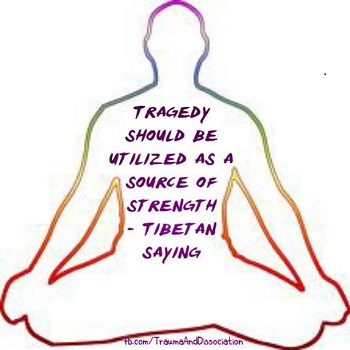
Picture: Flickr/ Trauma and Dissociation

Quote

Thought For The Day – Richard Jadick

Every veteran has at least one story that revolves solely around music. For me, it was seeing Toby Keith sing American Soldier while deployed to Iraq (for the concert he renamed the song to American Warrior since there were Marines and Airmen on the base and not just soldiers).  I don’t consider myself a fan of country music, but that was one of the best concerts I’ve ever been to in my life.

Toby Keith put on an amazing show and when he sang American Soldier, the experience of actually seeing American Soldiers singing along to the song, while at war, it was surreal. Something I’ll never forget.

I have nothing but the utmost respect for Toby Keith and all the other entertainers who trek overseas to perform for our troops. It’s an experience most of them will never forget.