Blogishness, military, ptsd, Uncategorized, Writing

Can Stress Make Us More Creative? Writing, Art, And Combat Veterans…

I was recently watching this Ted Talk titled How Frustration Can Make Us More Creativeand the talk is basically about exactly what the title describes: How frustration, those hair-pulling moments, can actually lead us to some of our greatest moments of creativity.

This got me thinking about combat veterans and why I’m seeing so many of them turn to the arts after the war.

Who doesn’t know about Edgar Allan Poe? He is famous around the world for his powerful poems and short stories, but not everyone knows that he was a member of the US Military before he became a great novelist (there’s even a funny story of him showing up naked to formation). Just like him, a lot of veterans are successfully letting go of their dark and traumatic pasts and venturing into self-expression through different art media.

[pullquote]”Sometimes, we need to go through those hurricanes and rainstorms, to see and appreciate the sun.”[/pullquote] The mid-1900s was really a dark period in history as this is when numerous wars took place. Members of the military had to be in the battlefield for many weeks, months, or even years. Aside from having no means of keeping in touch with their families, veterans were exposed to a hostile environments, without any avenue for peace and quiet. This intimidating and disturbing experience took a toll on most of them, even after the war. Unfortunately, a lot of veterans who served during the war(s) were diagnosed with Post-Traumatic Stress Disorder or PTSD, which could result to trauma, apathy, or depression.

Stress is a negative emotion and people have associated it with trauma, apathy, or depression. Because of what happened in the past, people somewhat expect veterans to be demotivated and a lot less outgoing. However, with the right mindset and tons of encouragement from family members, friends, and other concerned citizens, some veterans were able to overcome this stage in their life with the help of arts.

Psychologists have proven the power of visual, written, or performing arts as an effective therapy for people with PTSD. A traumatic experience could overwhelm a person; thus, he may distance himself away from people and completely avoid interaction. People with PTSD are usually scared to vent their feelings and emotions, worrying that any form of reminder of the experience they have been though could be unbearable. With the help of different types of art such as writing, painting, playing instruments, or performing in theaters, veterans now have a channel to let go of their suppressed emotions, fears, anxiety, and loneliness. Any of these mediums give a veteran a sense of entitlement and a spark of positivity, something that they have been deprived of during the war period.

Today, there are many non-profit organizations that serve as avenues for veterans to explore their creative side. These organizations provide support and training for veterans and help them smoothly transition from military to civilian life. They also pay honor and recognition to the invaluable contribution of our veterans with programs and activities that campaign and promote the overall well-being of U.S. veterans and their families.

Groups like Warrior Writers and Words After War encourage veterans to utilize creative writing as a means of communication and self-expression. Other groups such as the United States Veterans’ Artists Alliance (USVAA) and the United States Veterans Art Program (USVAP) offer a holistic approach and a more comprehensive artistic media such as music, theater, photography, and film. Despite the differences in each group’s method or type of approach, their goal and mission is one and the same — to help veterans let go of their traumatic past and realize that there is life after war, and it is beautiful.

I think this is why beauty can come out of some of the ugliest of places. Sometimes, we need to go through those hurricanes and rainstorms, to see and appreciate the sun. There is nothing uglier than war and it’s why so many combat veterans are flocking to the arts. The storms have filled them with creativity inside and they need a release. It’s also why I think so many therapies that help veterans with PTSD include the arts. There’s a certain pent-up-ness that veterans need to get out and if they keep it inside too long, it leads to mental constipation. Art gives them that release from the frustration.

Civilianized: A Young Veteran’s Memoir

In this dark humored War Memoir, Iraq veteran Michael Anthony discusses his return from war and how he defeated his PTSD. Civilianized is a must read for any veteran, or anyone who knows a veteran, who has returned from war and suffered through Post-Traumatic Stress Disorder (PTSD).
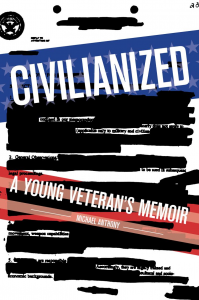
dark humored military memoir“An intense memoir.” -Kirkus

“I wont soon forget this book.” -Mary Roach

“A must read.” -Colby Buzzell

“[S]mart and mordantly funny.” –Milwaukee Journal Sentinel

“Anthony delivers a dose of reality that can awaken the mind…” Bookreporter

Order your copy of Civilianized: A Young Veteran’s Memoir .

Quote

Thought For the Day – Alden Nowlan (Growing up in War)

This quote, by the poet Alden Nowlan, really hit me at the right moment in my life. Recently, I had been reminiscing about my time in the military, particularly Iraq, and I felt this quote captured something that I had been trying to piece together for many years…

When I had first deployed to Iraq, I was only twenty years old. At that point, I had gone to college for a year, had been through army basic training and AIT–which included dozens of intense surgeries, and even delivering a baby or two–but even with all that, I went to war as an adolescent.

All of my commanders and NCOIC’s were older than me, by many years, and as I watched several of them struggle through being leaders and commanding troops, I constantly found myself pointing out their imperfections. I couldn’t believe, to put it bluntly, how shitty some of these people seemed–as leaders, soldiers, and just, humans in general.

Now, granted, some of my hate and frustration with my leadership was warranted–one sergeant major, two first sergeants, and a company commander were relieved of duty after all (and even all that was a bit of an understatement)–but it’s only now, years later, that I realized I had been viewing much of my leadership through adolescent eyes that expected “adults,” and older people to have all the answers.

I know now that “adults” don’t have all the answers, and never did, and that I was foolish to expect them to in the first place.

As I’ve traversed through the  ages that many of my leaders were in Iraq, I find it chilling to think of the responsibility that many of my fellow soldiers had at such young ages. One leader, for example, was only twenty-seven when he was in charge of the section I worked in. To me, at that time, twenty-seven might as well have been forty, but as I’ve turned twenty seven myself–and then left it behind–I shuttered to think of having such responsibility when still at such a young age.

Now, at the age of thirty, I have my own responsibilities, full-time employment, a wife and daughter to look after, a mortgage to pay, etc. But my responsibilities now are nothing compared to the responsibilities that a leader faces during war–and many of them were younger than I am now.

Perhaps there’s no perfect age to be a leader at war; after all, age doesn’t always equal intelligence, or ethics…

But, I guess what I’m trying to say is that I now realize how foolish it was of me to expect these “adults,” to be perfect people, perfect soldiers, and perfect leaders. Some of them were shitty leaders, don’t get me wrong, but I realize now that many of them were just doing the best they could in a shitty situation. Maybe it’s taken all these years for me to reach adulthood and forgive them (forgive, but not forget, many of those bastards are beyond any grace). But I guess that’s where I’m at and I think this quote by Nowlan summarized it up nicely.


Quote

Thought for the day – Staff Sergeant Old School

Another quote from Staff Sergeant Old School that’s spot on. I was never in a rifle platoon, but I did serve in the U.S. army and work in a medical unit in Iraq. And I can tell you from first hand experience, that even in war, I never laughed harder than with some of my army buddies. You’re working 24hour shifts, going weeks without down-time, you’re starving, tired, pissed-off, and yet you still somehow find yourself able to laugh with your friends–even if it is about how tired, starving, and pissed off you all are.


Quote

Thought for the day – Charles Bukowski

We must ask ourselves these questions: Will death welcome us, or will we welcome death? Will death scare us, or will death be scared of us? I know what I’d chose, what about you?

[This Bukowski quote/phrase was originally shown to me as a poem (however, the quote feature did not allow me to break it down by stanza); I will include the original formatting of the poem below.]


We are here
to laugh
at the odds
and live our lives
so well that
death
will tremble
to take us.

-Charles Bukowski

ptsd, Self Improvement / Healthy Living

How Stoic Philosophy Can Help Veterans With PTSD

Philosophy Sign Stoic PTSD

We all have a natural tendency to respond to various situations in different ways. Of course, that’s what makes us human. The flight or fight response is one of the body’s natural responses that occurs when triggered by a specific situation. When a person becomes scared or feels threatened, the body’s normal function amplify, helping the body prepare itself to face danger.

This phenomenon occurs rarely, so most people don’t feel ‘flight or fight’ on a regular basis. What if someone did happen to respond to most situations this way—if their body couldn’t ‘shut off’ its natural flight or fight response?

‘Flight, Fight or Learn to Cope?’

“Stoicism, in the modern world, can essentially help people cope with pain or hardships (emotional and physical trauma) by helping people accept the inevitable, or what has happened, without reacting in a way that’s ruled by their emotions.”

People with PTSD may feel constantly fearful or stressed even if they’re not in danger. This mental condition develops following a traumatic experience, whether the experience involved direct physical harm or a threat of physical harm. In most cases, people who develop this debilitating condition were directly involved with the traumatic experience. Some also develop the condition after experiencing several, smaller traumatic incidents.

The scary thing is that PTSD can develop in anyone who has suffered through traumatic experiences. Many people recognize this condition as something that veterans and the currently enlisted suffer through, but it also affects many civilians who have lived through extremely emotionally and physically distressing situations.

Post traumatic stress disorder is traditionally treated and managed through various types of therapy and medications. In recent times, both doctors and patients have discovered and utilized alternatives to help alleviate many serious symptoms of this debilitating condition. An unconventional, yet familiar way to treat PTSD involves changing one’s way of thinking, usually through affiliating oneself with a new religion or life philosophy.

Stoicism and Learning To Cope

Stoicism is an ancient Greek school of philosophy, originally founded in Athens by Zeno of Citium. Stoic philosophy originally taught that ‘virtue (the highest good) is primarily based on knowledge and the wise harmoniously live with divine Reason that rules nature.’ Those under Stoic philosophy ‘also remain indifferent to the variations of fortune, pleasure and pain.’

Stoicism, in the modern world, can essentially help people cope with pain or hardships (emotional and physical trauma) by helping people accept the inevitable, or what has happened, without reacting in a way that’s ruled by their emotions. The idea is that whatever happens has happened by means of forces they can’t control, and so it has no real bearing on their character.

In this way, stoicism acts as a ‘practical guide for life.’ While it helps teach people how to deftly approach situations, it also encourages people to become more mentally tough. The lessons people can learn from stoic philosophy makes it a natural philosophy for veterans and the currently enlisted to cope with their traumatic experiences.

How Does Stoicism Help Veterans Cope With PTSD?

“Traumatic experiences distort how people coexist with nature and society, making people act unnaturally, far away from how their true character would actually act.”

As mentioned, stoic philosophy has the potential to help veterans learn to cope with post traumatic stress disorder. The main way that veterans can utilize this life philosophy is learning how to flourish as a human being. According to Stoicism, the main goal of life is to flourish: to live in continued excellence, to live happily, to live with a peace of mind, to live as a strong character and to live with enthusiasm for life.

People with post traumatic stress disorder have had their cognitive functions inhibited to a point that prevents them from adopting healthier behavioral patterns. This, naturally, inhibits their ability to truly enjoy and flourish in life. PTSD forces a person to develop a type of ‘traumatic functioning,’ which puts them in a situation where they feel as if they’re stuck in a mode that prevents them from being ‘normal.’

While people don’t stay in one mode forever, many do switch between the various modes of traumatic functioning. Stoicism can help people break away from the cycle, helping them flourish as human beings again.

Character, according to stoicism, is our ability to tell apart good from evil and act upon our interpretation. How people weave themselves through nature determines their character, based on how they act on the inside. Stoicism also teaches that external elements don’t help people flourish, but it’s how people use those elements to build character if they choose.

According to stoicism, people can become harmonious once again with nature, as long as they can return to their true character. Traumatic experiences distort how people coexist with nature and society, making people act unnaturally, far away from how their true character would actually act. Stoicism helps people return to their true character by teaching them how to keep their character harmonious with nature.

Learning to Cope with Stoicism

Stoicism may help people with PTSD learn that ‘whatever occurs has happened by means of forces they can’t control, and so it has no real bearing on their character.’ For those involved in traumatic experiences related to war, stoicism can help them eventually accept the inevitability of what likely happened during their time in service and, eventually, learn how to cope.

For more information about stoicism and veterans, read this blog post: http://www.dailykos.com/story/2015/06/29/1397640/-Stoicism-for-Trauma-Survivors-Part-1

Picture: Flickr/dakine kane


Quote

Thought for the Day – The Iliad

In one way or another I’ve said this quote to myself thousands of times throughout the years. I think every soldier has a similar quote they repeat to themselves.

The military is tough, there’s no question about it. From basic training, to war, and then coming home. But the best thing it is that when struggles do arrive, as soldiers, we know deep down that we’ve been there before, and have survived. We’ve struggled, we’ve gone days without sleep, days without food, left our families behind, endured physical and mental trials, and we survived it all.

For me, one time I always repeat the Iliad quote is when I’m sick.

If I get a bad head cold, I’m one of the biggest babies ever. All I want to do is curl up in bed, watch reruns of The Price is Right, drink honey tea, and just wait out the cold with a blanket over my head. This though, as an adult, is not an option. After allowing myself to wallow in pity for a few minutes, I repeat some form of the above quote, and then remind myself of a story.

Way back in 2005 I was a young soldier; I was living in barracks at the time–during my AIT training–and a few of us came down with the flu. It was awful, we were puking, dehydrated, and had that disgusting lethargic feeling. And the worst  part: there was nothing we could do about it. We still had PT every morning at 4:00am, and then had 8-12 hours of schooling, etc. Sick call didn’t open until 6:00am and we couldn’t miss any classes because our training was incredibly difficult (we had two tests a week and if you scored anything under a 79 you were on academic probation (under 75 was failing)). One morning after a hard run during PT, two of us blacked out from dehydration. Once we came to, we didn’t go to sick call, we just drank a bottle of water and went back to our training. By the time the weekend rolled around, and we were finally able to go to sick call, two of us had 103 temps and one had a 104 temp.

It was the sickest I had ever been in my life (a week later strept throat was going through the barracks and a bunch of us got that too!). But I toughed it out. And now, whenever I get sick and just want to curl up in bed, I remind myself how sick I was then, and how much I still was able to accomplish when at my worst.

We’ve all had tough times and life and have survived them. If you’re going through a tough time, just remind yourself “I’ve been here before, I’ve survived, and I will again.”


Uncategorized

How Writing can Help Veterans with PTSD?

Post-Traumatic Stress Disorder (PTSD) is a mental illness that results from a highly stressful, traumatic, and life-threatening experience. It is important to note that not every individual who experiences a traumatic event will suffer from PTSD. It all depends on the mental state, overall mental health of the sufferer, the trigger, as well as other risk factors that an individual is exposed to i.e. alcoholism, drug addiction, genetics, the lack of family and friends, disaster, calamity, etc.

Signs of PTSD

PTSD manifests itself to the sufferer in different ways i.e. flashbacks, nightmares, hyperarousal, etc. External signs of PTSD vary from person to person. Signs usually include increased wariness, jumpiness, a sudden change in behavior, paranoia, violence, etc.

US Veterans

When we talk about US war veterans, we talk about any war or armed exercise that the United States has been involved in, whether in the past or recently. This presupposes that there is still a survivor of the said war. Sufferers are not limited to combat personnel. PTSD can also be experienced by medics, chaplains, nurses, administrative personnel, etc. This includes any situation, exercise and military incursion wherein any serviceman is exposed to a traumatic experience.

These include, but are not limited to:

  • Vietnam war
  • Panama invasion
  • Gulf War
  • Somali civil war
  • Iraq war
  • Afghanistan war
  • Pakistan war

PTSD Statistics

A recent study shows that around 60% of men and 50% of women will experience some sort of trauma in their lifetime. Because of the nature of PTSD, a substantial percentage of sufferers include war veterans. It is estimated that 20% of US soldiers who were deployed in Iraq and Afghanistan suffer from PTSD. This translates to around 2.7 million veterans. Going further back, there were around 8.2 million soldiers deployed in the Vietnam War. Roughly 2.6 million of these war veterans developed some form of PTSD.

PTSD as a Curable Mental Illness

PTSD has been present in every armed conflict or war that humanity has been involved in. However, in the United States, it was only during World War I when PTSD came into center stage. Previously, people who showed signs of PTSD were thought to be psychologically lacking, even brain damaged i.e. weak-willed, weak-minded, and emotionally unstable.

Gradually, psychiatrists came to realize that experiences trigger emotions, which in turn lead to “shell shocked” soldiers. In other words, being shell shocked does not stem from psychological inadequacy, from a mental illness. This point of view was the start of what is known today as PTSD. More importantly, physicians realized that this illness is curable, with pre- and post-management and medication.

Management and Care

PTSD management and care is a mixture of proper care, medication and support. The military has its own department when it comes to identifying, caring for and managing PTSD veterans. Some methods for PTSD management and care include psychological therapy, cognitive behavioral therapy, eye movement desensitization and reprocessing, interpersonal psychotherapy and medications (i.e. Benzodiazepines, Glucocorticoids, Cannabinoids).

Alternative Forms of Therapy

These forms of therapy are best utilized to augment mainstream PTSD management and care. These include but are not limited to exercise, sports, as well as taking up some form of physical and mental activity.

Expressive Writing and PTSD

One way to speed up the process of healing is to write about the experience. Writing helps because the sufferer controls the flow of thought and the detail to be put in. The sufferer is encouraged to start with a single word and progress slowly. At first, the sufferer does not even have to write chronologically. Snippets of thought are enough. The sufferer is then encouraged to add details then arrange the same in a manner through which he is most comfortable in, i.e. chronological, importance, shock factor, etc.

When asked why it works for some, one proponent, who also suffered from PTSD says: “You control what you write. You control what you disclose. You control the memories that you want to put forth. This control helps empower the sufferer, who, for all intents and purposes, has lost control over his emotions, to the traumatic event/s of the past.”

Case Study

Studies show that expressive writing does not exacerbate the symptoms of PTSD. On the contrary, it actually helps improve the overall mood of the individual. In addition, a significant number of psychiatrists observed a positive increase in post traumatic growth. Needless to say, a person suffering from PTSD is encouraged to seek the advice of a licensed psychiatrist who specializes in the same disorder.

Civilianized: A Young Veteran’s Memoir

In this dark humored War Memoir, Iraq veteran Michael Anthony discusses his return from war and how he defeated his PTSD. Civilianized is a must read for any veteran, or anyone who knows a veteran, who has returned from war and suffered through Post-Traumatic Stress Disorder (PTSD).

dark humored military memoir“An intense memoir.” -Kirkus

“I wont soon forget this book.” -Mary Roach

“A must read.” -Colby Buzzell

“[S]mart and mordantly funny.” –Milwaukee Journal Sentinel

“Anthony delivers a dose of reality that can awaken the mind…” Bookreporter

Order your copy of Civilianized: A Young Veteran’s Memoir .

Quote

Thought for the day – Colby Buzzell

Every person who has ever served (and those who wished they did) will understand this quote from Buzzell’s book (which he actually attributes to as an old Chinese saying). No one wants to be left wondering “What could’ve been.” The good thing though, is that the age of enlistment has been bumped up to 39yrs. So if any of you guys or gals are still wishing to serve, head on down to your local recruiting office!